Everyone has different views and opinions that are informed by a multitude of factors including our education, up-bringing and morals. So it’s hardly surprising that we don’t all share the same view of what we consider as ‘beauty’.
Earlier this year, Zara, a Spanish fast fashion retailer released a campaign featuring Chinese model Li Jingwen which sparked outrage on Chinese social media. Many people were irritated at the campaign and vented on social media about it under the hashtag “Insult to China.” (May, Mou 2019) According to the New York Times, one commenter wrote, “Why are freckled faces misconstrued as high fashion?”, while another wrote, “just the West’s beauty standards for Asians, very different from ours. For those women to be called the most beautiful in Asia feels like discrimination to the rest of us.”(May, Mou 2019) It’s clear that many people believed Zara were being culturally insensitive by trying to push Western beauty standards onto the Chinese community. However, Zara posted a response on PearVideo saying that the campaign was for “global markets” and “our headquarters in Spain picked the model, they might have a different beauty standard… And we didn’t photoshop the photos”. (Chenyu 2019) Although it seems Zara never intended any harm with their photoshoot, it’s interesting to see how a seemingly small design decision created such an uproar.
The image itself depicts the home screen of a Zara webpage advertising their beauty products. On the left is their usual set-up of the shopping categories as well as their logo. On the right two thirds is a close up portrait of Jing Wen. Her face is angled to the right and her expression is quite monotone, with her eyes gazing towards the camera. The background is empty, her hair has been slicked back from her face and her clothing is black which ensures that the viewers eyes are drawn to her face, in particular the dark pink lipstick that they are advertising and also -perhaps unintentionally- her freckles. As her freckles are so visible, it gives the campaign a ‘natural’, unedited and fresh feel. Situated on top of her cheek are the large words “Beauty is here”, accompanied by some smaller type that reads “paint it matte, shine bright, ultimate, perfume”, making it obvious that the photo is an accompaniment to their advertising of beauty products. (fig.1)
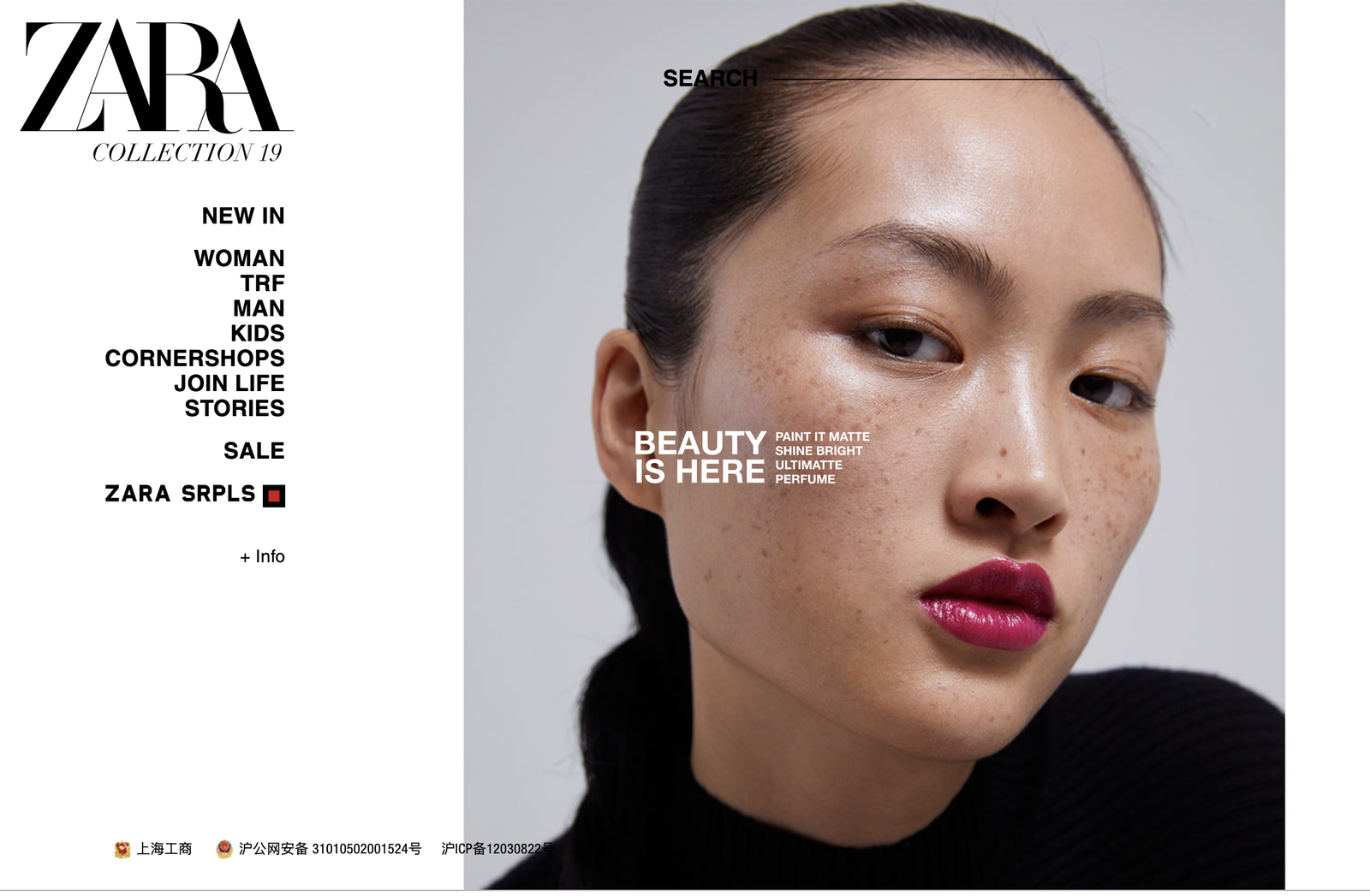
I found it very interesting to read about this campaign and people’s abhorrence to it because to me personally, if I saw this on the Zara website, my only thoughts would be that it’s cool that there is Asian representation. To me, her freckles aren’t ugly, and she simply looks fresh faced and digitally unaltered. However, this just further proves how different people’s standards of beauty are because for so many people in the Chinese community, the freckles are hideous. As someone who is Australian born Chinese, it makes me wonder how differently my perceptions of beauty would be had I not been born in regional Australia.
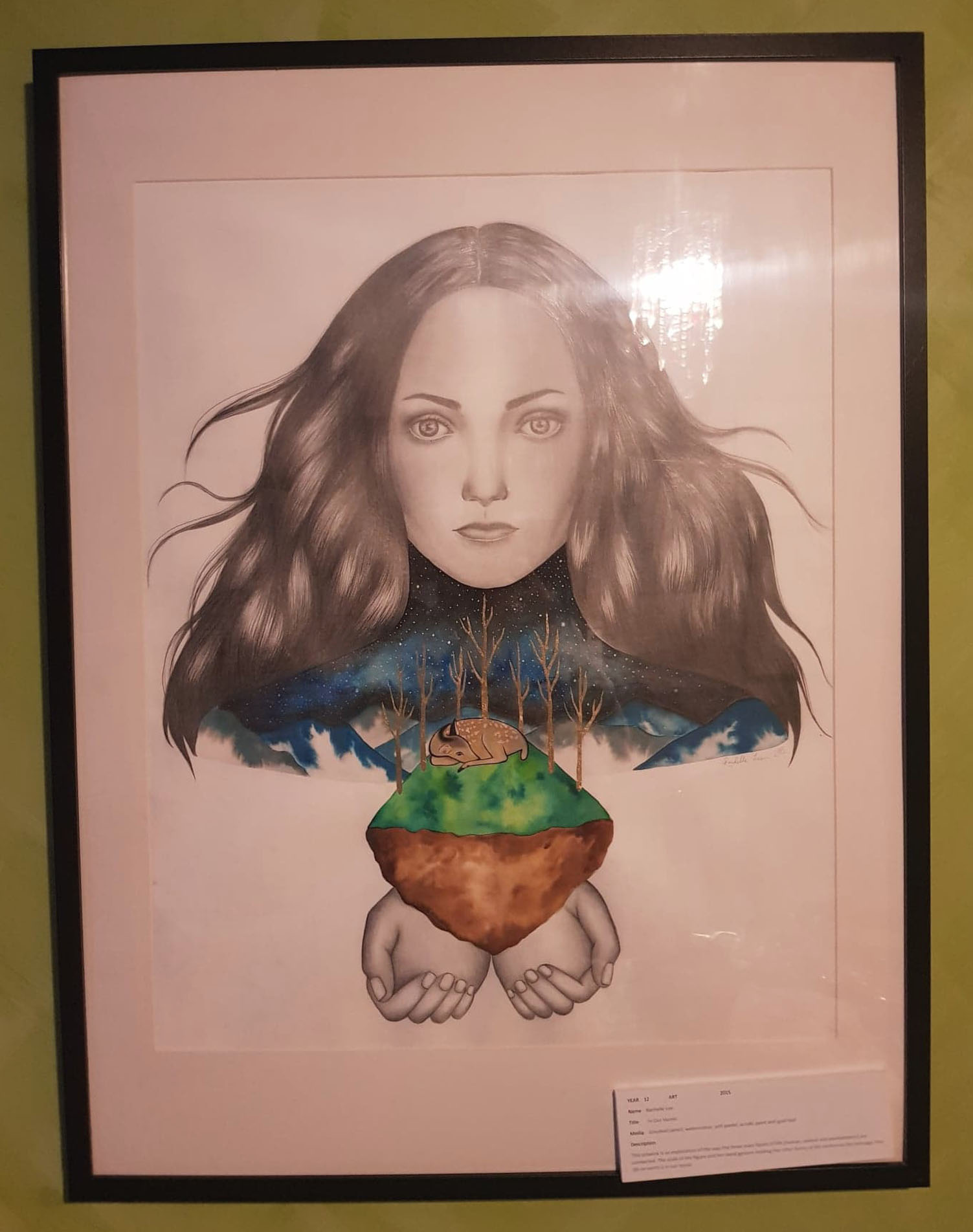
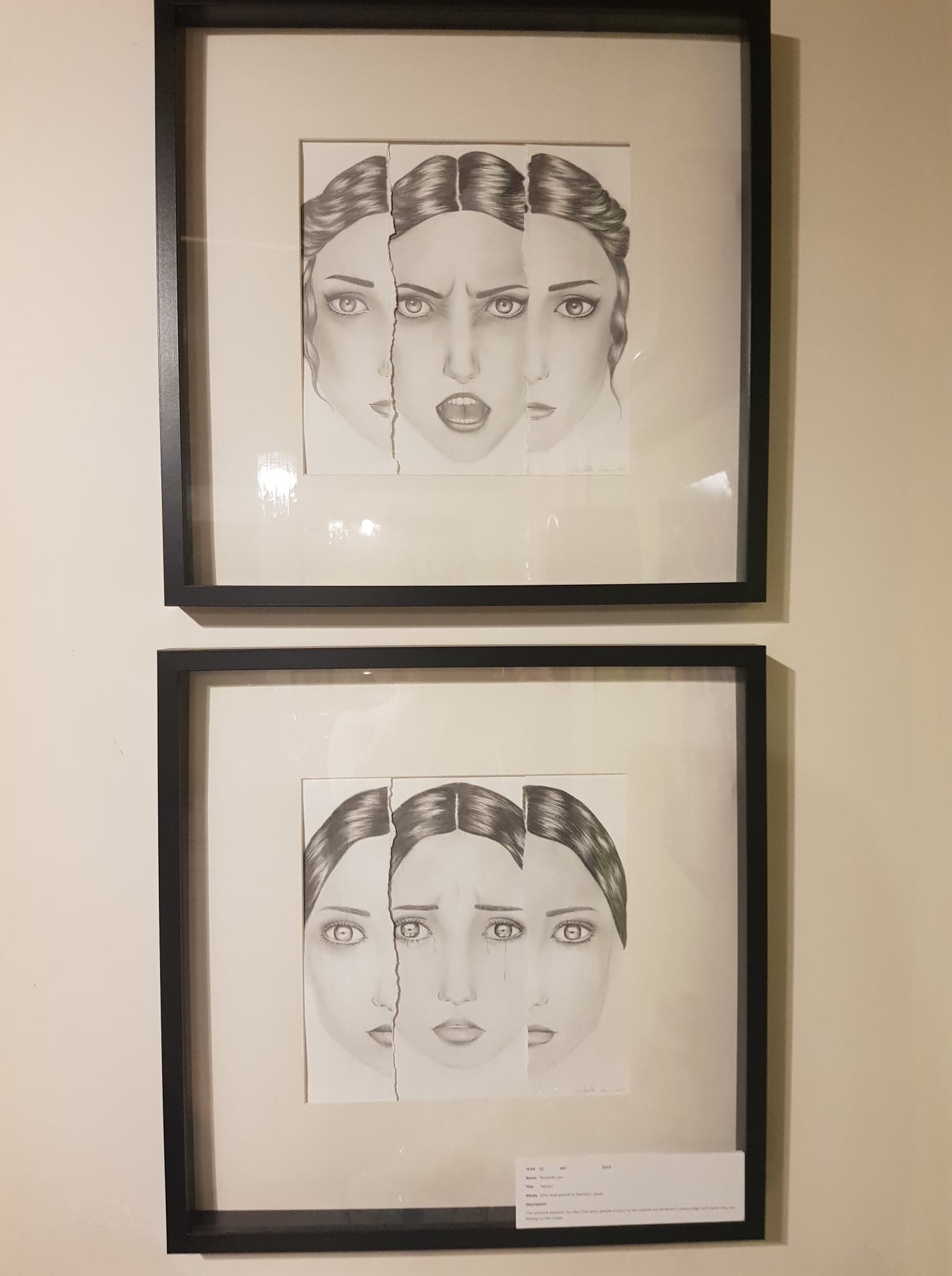
Growing up on the Mornington Peninsula, I was surrounded by Caucasian people. Not only that, the media around me, from movies, to books to advertisements also lacked in cultural diversity. Consequently, growing up, I always thought that Caucasian people were the most attractive group of people. This is very evident in the fashion illustrations I used to do, where I would draw skinny, white women with large eyes and pointed noses and it never occurred to me to draw people from other races. For my Year 12 VCE final pieces for art, I created three portraits of women, that were all Caucasian. The former artwork (fig.2), was based off a photo of a friend, so I do think it made sense that she is fair-skinned, with long wavy hair and large eyes, however for the two other faces (fig.3), I actually used a few different references of models and made up faces. And as you can see, they all have Caucasian features.
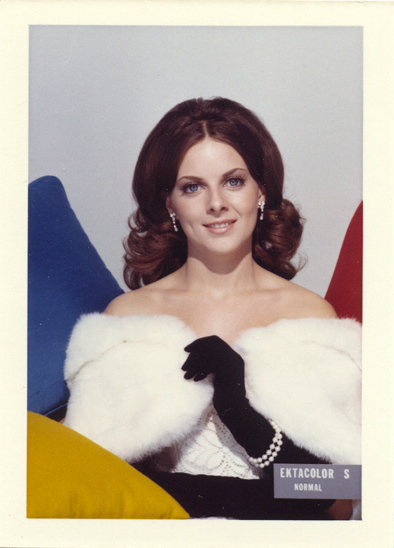
The way in which I unconsciously made these decisions aligns to the issues brought forward in Dimeji Onafuwa’s journal, “Allies and Decoloniality : A Review of the Intersectional Perspectives on Design, Politics, and Power Symposium” (Onafuwa, 2018) Onafuwa describes how the lack of awareness of designers can be discriminatory without them even realizing. (Onafuwa, 2018,). In the 1950s, there was an issue with the Kodak Shirley cards (fig.4) because for years, it was used by photo labs to calibrate skin tones, shadows and lighting during the printing process. (Del Barco, 2014) The film was flawed because it meant that if wasn’t suitable for people with darker skin and if a photo was taken featuring people with different skin tones, the shot would come out as partially under or over exposed. This goes to show how representing only one race is troublesome.
While it is clear that standards of beauty differ from person to person, it’s important to be culturally aware and encourage diversity so we don’t relive the same mistakes of the past.
References
Chenyu, Liang. “Chinese Netizens Decry, Then Defend, Zara Model’S Freckles”. Sixth Tone, Last modified 2019. https://www.sixthtone.com/news/1003572/chinese-netizens-decry%2C-then-defend%2C-zara-models-freckles.
DEL BARCO, MANDALIT. “NPR Choice Page”. Npr.Org, Last modified 2019. https://www.npr.org/2014/11/13/363517842/for-decades-kodak-s-shirley-cards-set-photography-s-skin-tone-standard.
May, Tiffany, and Zoe Mou. “‘Insult To China’: A Model’S Freckles Spark An Online Storm”. Nytimes.Com, Last modified 2019. https://www.nytimes.com/2019/02/19/world/asia/china-freckles-zara-jing-wen.html.
Onafuwa, Dimeji. “Allies And Decoloniality: A Review Of The Intersectional Perspectives On Design, Politics, And Power Symposium”. Design And Culture 10, no. 1 (2018): 7-15. doi:10.1080/17547075.2018.1430995.

 Design Research
I’m really interesting in your blog about the definition of beauty. And I agree with your opinion, I think everyone has different view of the beauty, because of their different education, environment and morality. As you mentioned, the pictures of female model appeared in Zara magazine. The expression in her face, her hairstyle and the obvious freckles on her face are not the beauty of the Chinese aesthetics. I’m the international student from China, as I think, most Chinese people will think the face with no freckles is beautiful women. It is not like the picture showed on the magazine.
In my opinion, to become a good designer what we need is that when we design a product for the particular group of people, we need to learn there culture, to think a lot of customers. As I know to learn a new culture and understand it is hard, but I think it is the responsibility for designer to do that.
LikeLike
This blog posts you wrote let me have a lot of feelings, from your blog, I know the Chinese, Spanish and you understand is how of beauty is different, the Chinese feel that facial features stereo, skin without any flaws is beautiful, the Spanish think natural skin is beautiful (freckles visible), because you grew up in the white majority in the environment, so you think white skin is beautiful. In fact, for these standards of beauty, there is no so-called right or wrong, everyone has different standards of beauty, which is a very normal phenomenon.
However, with regard to this advertisement of Zara, I think that rather than researching the Chinese market, Zara directly publicizes its natural, unedited and fresh feel in China, which seems to run counter to the aesthetics of China (freckles are rather fearful to many Chinese people). As an international brand, Zara should have a certain understanding of the aesthetics and customs of each country.
I think Zara’s international team should include people from different countries, so as to include ideas from different countries and create more possibilities.
LikeLike
I really like the part when you talk about your view on beauty when you were little and I agree that one of the reasons behind that is the lack of social diversity in the media. For many people, the western beauty standard seems to be the “it” standard. Globally, many famous fashion companies mainly use western models for their campaigns and same goes for many asian small retail stores and companies. Coming from Vietnam, I have seen a lot of Vietnamese retail fashion stores these days prefer having white models for their lookbooks.
I find Victoria’s Secret has had many similar issues on beauty standard. Couple years ago, when we talked about the Victoria Secret models, we mostly thought about white models and today, we can see a lot more successful asian representatives, which is great. I also agree when you talk about how one very small detail of a campaign can create such controversy. Back to Victoria Secret, they once had a slogan called “The perfect body” and people said that the advertisement might make women think that their bodies do not fit in the “perfect” standard, and just like Zara, VS might try to push their own standard of beauty forward.
LikeLike
It seems undoubtedly right that intersectionality in varying types of oppression causes tension between people that weigh each area as more or less critical, this means that when you decide if the advertisement campaign is justified means you have to make a valuing between cultural sensitivity and the harms of unrealistic beauty standards. For me, the challenge is to work out where the nuance lies and see how to integrate the different axis of oppression so that a thoughtful and genuinely kind outcome can be found.
I think there is also rifts inside different parts of the same movement like Feminism (or should they just be called Feminisms). For example, the distinction between 2nd and 3rd wave feminist in regards to women using their body for financial gain. Should supermodels be encouraged as a form of expression and freedom or condemned for failing the women’s rights movement?
Perceptions of beauty and pop-culture are the front line identity politics or to take the term from Barbra Kruger; ‘your body is a battleground’.
After having all these thoughts, I am left with the worry I have no right to be part of these discussions and that by voicing my opinions I am doing no good or perhaps harm. I think that those with power should know when to cede it when it improves the world or furthers there ideals.
LikeLiked by 1 person