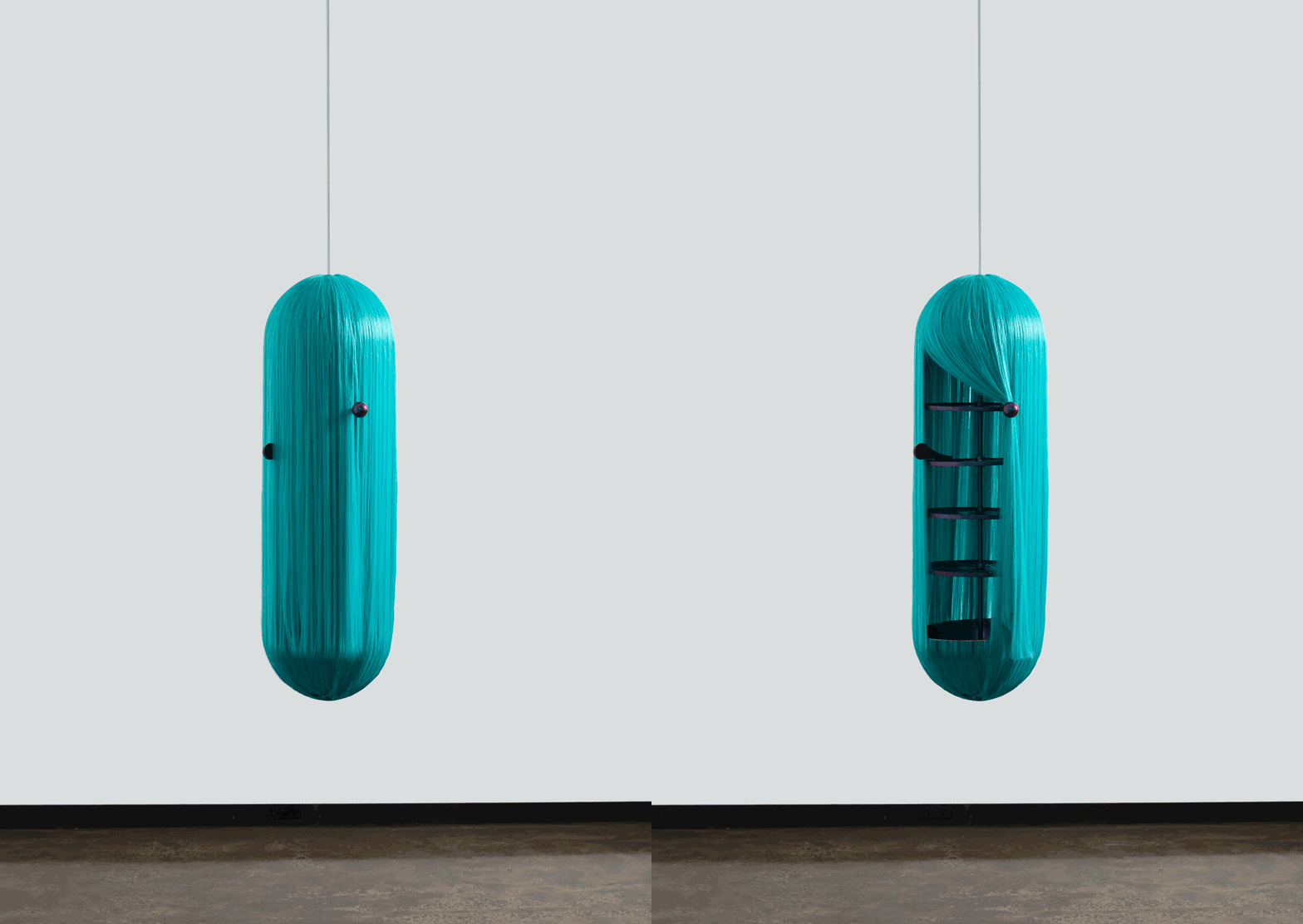
In the Designing Women NGV International exhibition, many works of contemporary female designers are displayed. The Weaver is a work showed in this exhibition which is designed by Elliat Rich in 2018 (seen figure 1). The Weaver is a cabinet, but it is not look like what we think a cabinet should be. Its colour scheme, appearance and material use are out of ordinary. What Weaver is, however, it is difficult to describe it.
Weaver is both a cabinet of curiosity and a sculpture in equal measure. In a real sense, Weaver is a cylindrical shelf hanging on the ceiling which is covered with a curtain of synthetic turquoise fibre (Carolan, 2018).. This kind of material which is used for wigs. Inside, four shelves are coated with pearlescent pigments that glow like a rainbow when the light hits them (Carolan, 2018). Elliat Rich boldly used synthetic materials and created a visually striking colour and shape it looks like a pea or a pill. What makes this work more attractive and personalized is a detail contained in it, the curtain “hair” of turquoise synthetic fibre pulled behind the metal “little ear”, just like a lovely girl tucking a wisp of flowing hair behind her ear, which is a charming body action (Carolan, 2018). “It’s really quite intimate [that gesture]. It’s like having this relationship with this sculpture furniture that has a presence and a personality.” Says Rich. The vivid work Weaver which Rich designed invites us to consider the possibilities of brighter, as well as the more hopeful future navigated toward with the aid of design that turn us to the people, places and events that matter to us most. Its characteristics combined with human body perception and products, this work is endowed with personality through a person’s behaviour and actions. It resinates with people. Elliat Rich said that (Domusweb, 2019),
“This is the beginning of a body of work exploring ways of being in the future, I really feel as designers that we have this amazing opportunity to inspire visions of the future. At the moment there’s this dark, dystopic [idea] that the future is dark and that technology is going to kill us. There are very few beautiful visions of the future that give us [hope] and instructions or a clear vision of where we can go.”
It is easy to see the futurism in the style of the Weaver, which breaks through the existing design forms and conventions. The Weaver is a challenging design. It is not only a product, but also an art sculpture, if you appreciate it carefully, you will be deeply attracted by one of its characteristics. Although it is an avant-garde or fashionable work, it is controversial when it is considered as an industrial product (Domusweb, 2019). People are subconsciously influenced to consider the functionality or utility of a product or to compare its value with its price. However, in order to meet the public demand, designers usually pursue the simplicity, utilization, functionality and mass production of industrial design products (Slaughter, 2019).
For now, when a product is needed to spend a lot of time and money and might does not necessarily conform to the public aesthetic, designers will consider whether it can be mass produced or it conforms to the public (Jakobsone, 2017). And then people will evaluate whether it is a good industrial design product. For example, when people go to Ikea to buy products, every product you see, you will know at a glance what it is and what its function is. You will buy it because you need a table, a chair or a lamp. The designer will consider the combination of its appearance and function for people to choose and find products easily. In contrast to Weaver, when people see it for the first time without any comments, they even need to observe it and consider what it is. Moreover, not everyone will understand and appreciate the unusual appearance and the detail of design showed on the Weaver. Like if people want to buy a shelf, they often think about the size of its capacity, which means its utility, and the amount of space it takes up, whether it’s appropriate to install it at home. And then they will consider the price, is the price they could effort (Jakobsone, 2017).
If the feature of the mainstream industrial design products is functional, simple, practical and technological. Whether it can only be regarded as a kind of excellent artwork, rather than an industrial product.
In my opinion, I couldn’t just give one definition of the Weaver which it is a good industrial design or not, or it is just a good sculpture artwork. As I think, Weaver provides a new direction and new thinking way for the future design. This does not mean that it will replace others or intend to change the current definition of a good industrial design products. Designers today, the starting point for their creations is usually to discover a problem, then find the solution, in order to solve the problem to create the product, in simplified words, design is often described as a problem solving activity (Jakobsone, 2017). But for Weaver the designer Rich rather to identify problems which are existing or yet to come, and Rich prefer to ask questions instead of providing answers, for example, although this work is different from the mainstream industrial products-high cost and high time consuming, the designer Rich still creates the Weaver in the process of exploration (Carolan, 2018). And Rich successfully expressed the standpoint in this work-how can people realize that the changed we make now will affect our future life (Carolan, 2018).
Design is a discipline of divergent thinking. Every designer might has great potential to create new things (Jakobsone, 2017). The reason why I think Weaver can’t be classified is that in the current design education concept the unique Weaver is different from the industrial products. But this difference does not mean forever and the future. It is just a different industrial product in people’s mind now. Maybe in the future, it will become the new direction of design.
Reference
Carolan, Nicholas. From The Red Centre To The Heart, Design That’s Going Places.2018. (accessed 8April, 2019).
Domusweb.it. Australia. A profile of Elliat Rich.2019. https://www.domusweb.it/en/design/2018/08/10/australia-a-profile-of-elliat-rich.html (Accessed 11 Apr. 2019).
Jakobsone, Liene. Critical design as approach to next thinking. 2017. (accessed 8April, 2019).
Slaughter, Anne-Marie. Why Women Still Can’t Have It All. 2019. (accessed 11April, 2019).

 Design Research
The first paragraph really intrigued me straight away; I knew instantly what the artwork was and what it was that interested you about it. You go on to describe the artwork clearly since there are a few elements that aren’t visible in the image that was provided in the article. When explaining the reason behind the artwork, I like how you contrasted the Weaver concept to the Ikea products, instead of using comparisons which is a typical direction to go.
I also researched Elliat Rich for one of my blog posts, so it was good that you made it clear that the artwork doesn’t have a simple answer. You researched and learnt that Elliat Rich doesn’t do things simply and I understood that from my own research.
There are a few extra adjectives in certain sentences, and just be careful of where you put commas so that sentences can flow easier when reading it (having some bigger sentences is totally fine). A close-up image of the shelf would’ve been great, so that I could visualise the discussion you had about the rainbow pearlescent pigment on the shelves.
When discussing the artwork and how it represents the image of a girl tucking her long hair behind her ear, do you know why Rich though to use turquoise since most girls don’t actually have that colour hair?
LikeLike
Really thanks for your comment to my Blog, as the project I put on the Blog, actually it is a GIF, and is also show the inner shelf and the move action. But it is a good ideal that I need to put a clear pictures for the inner design of this product.
Your question is something I haven’t thought about, but it’s a very interesting way to think about it. As far as I know, I think Rich is a very futuristic designer. Maybe she is not limited to the normal hair colour that people think is suitable for girls now. And I think the green out look is really attracted me. It’s a really unique work!
LikeLike
Unlike more commercial design, although this artwork is untimely, it presents the project into a possible, prototyped future. The background behind the artwork that you explained it clearly. I can understand the designer’s ability to forecast that through an extrapolation into the future by comparing Weaver concept with Ikea. This is Future? This is Design Future I wondered?
You discussed the artwork really good that make me interested it as well.From the GIF at the beginning, it shows the artwork of how it looks that the image of a girl tucking long blue hair behind her ear,. The artwork is attractive because of the bright and unnormal hair color.The question for this design, why is this color? And if the design is a practice that grounds itself in the present while projecting scenarios forward into the future, is it a critical practice?
LikeLike