
Forgotten superhero in graphic design

Image 1, Book cover created by Alison Forbes, I Can Jump Puddles written by Alan Marshall (https://abda.com.au/2017/07/10/alison-forbes-book-design-pioneer/, accessed 07/04/2019)

Alison Forbes as a full-time graphic designer, she has made a great effort on pushing the development of Australian culture as well as influenced as a female designer from graphic design. Alison Forbes was also a book cover graphic designer, and she had put into the Hall of fame (AGDA) in Australia. According to the reading Plotting the Historical Pipeline of women in graphic design written by Jane Connory, I learned that people did not pay attention to works designed by women graphic designers. The increasing numbers of female students in graphic design didn’t solve the problem of the statue of women designers.

Jane Connory considered that (Plotting the Historical Pipeline of women in graphic design, 2017, p2-p3) in 1985, although graduate women students outnumbered men by almost three to one from all Australian universities, the future society situation and future prospect make students feeling overwhelmed. At this stage, female graphic designers were facing the same position as the graduate feminine graphic design which is the unshakable female social status. However, although there were no female graphic designers participated in the AGDA first National Executive meeting in 1989 as well as all the chef and chairman were all males, Alison Forbes has received the AGDA first honor award for her continued and outstanding contribution on the production of Australia book covers design. According to the AGDA Hall Of Fame, her contribution including that she was the first full-time individually independent book cover designer in Australia,  her illustration for Alan Marshall’s I Can Jump Puddles has confirmed in the Australian Book Publishers Association (ABPA) Books of the Year as well as she became the first staff designer at Melbourne University Press at the age of 23. Her works occupied the most critical position in the development of Australia culture (Turning Pages: The brilliant career of Alison Forbes, designer, Jane Sullivan).

The methods Alison Forbes used for creating this artwork (Image 1) are paper, paintings, pen tool, and printmaking. Those are all traditional methods at that time. By using these tradition tools, Alison Forbes had done a lot of incredible works. However, the main ideas of graphic design now were mostly about numerous of inspirations and the requirement of works efficiency. There were millions of students graduate every year, and this caused high pressure and competitive. Because there are billions of ideas and works coming up every minute, so the process of complete a design needs less time than before. Otherwise, this unique idea will turn up from another graphic designer and will also be published by another company.

Although the process from ideas to a specific graphics product finish within a short period, the quality of the result was much better than before due to the rise of technologies. Also, the rapid development of society has led to an increase in work efficiency. Companies need more ideas that come from a professional graphic designer; the companies need prototypes, videos about their graphic works. Therefore, graphic designers from today have the knowledge on using technologies to made book covers, DVD covers, a variety of software used to edit videos, and also digital sketches on a computer, such as using an Adobe software called Photoshop and another Adobe software called Premiere Pro. These technics methods have changed the way graphic designers thinking and inspiriting because of the combination of traditional hand painting or making and the latest technologies with achievement in today. In addition, an important reason that people have forgotten most of the female designers including Alison Forbes was because of the society of female graphic designers.

The computer has replaced most of the works which used to finish by hands years ago. Consequently, computers and other electronic devices have made the aesthetic different compared to the last decade of years as well as people read books on their phone online. To buy a book will more about a collection. Although the book cover design works from Alison Forbes had occupied the most important position during the developing of Australia culture and graphic design field, female designers still need to speak for themselves.

Reference

Image 1, Book cover created by Alison Forbes, I Can Jump Puddles written by Alan Marshall (https://abda.com.au/2017/07/10/alison-forbes-book-design-pioneer/, accessed 07/04/2019)

Dominic Hofstede professional, Turning pages: The brilliant career of Alison Forbes, designer, accessed
05/04/2019 https://www.smh.com.au/entertainment/books/turning-pages-the-brilliant-career-of-alison-forbes-designer-20180510-h0zx0a.html

Pamela Ruskin, Alison Forbes, accessed 06/04/2019 https://recollection.com.au/biographies/alison-forbes

Jane Connory, Plotting the Historical Pipeline of women in graphic design p2-p3, p5-p6

ABC company, The Land That Waited, accessed 07/04/2019 https://aso.gov.au/titles/tv/the-land-that-waited/clip1/

ABDA Blog Alison Forbes: a book design pioneer, accessed 07/04/2019
https://abda.com.au/2017/07/10/alison-forbes-book-design-pioneer/
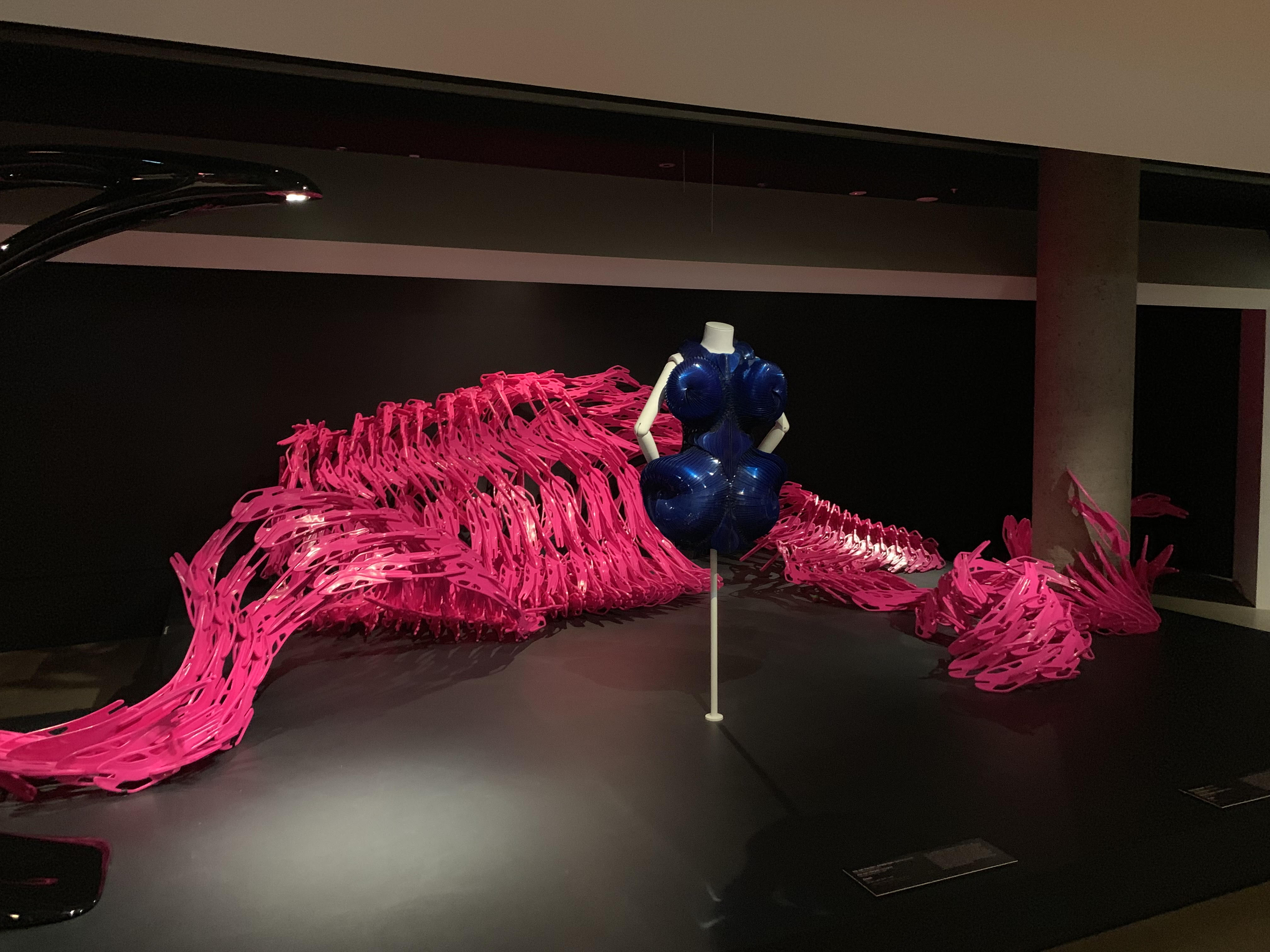
What materials did you consider designer used in this dress?

Image 1. Dress 2011, Iris Van Herpen, Amsterdam (fashion house), Iris van Herpen (designer), Photographed at National Gallery of Victoria (NGV)

Iris Van Herpen is a well-known woman Dutch fashion designer; her series of works demonstrated in-depth study on materials as a research designer. She cooperated with other designers, such as architecture and industrial designers. The Dress (image 1) 2011 shows a great result of a dress made by different materials instead of using needles or thread. Iris Van Herpen used a 3D printer to produce lace structures were no need for needles and thread. Also, she has applied different hand plisse techniques that are mostly forgotten today. To compare between the traditional hand plisse techniques and the modern mechanically folded plisse, the result of the hand plisse techniques was more organic and changeable. Iris Van Herpen considered to used modern technic to mimic nature reality. According to Iris van Herpen studio, Dutch fashion designer Iris van Herpen is a famous creator that known as one of fashion’s most forward-thinking research designer, because she has pushed the boundaries of fashion design forward. During her first show in 2007, van Herpen has been focused with discovering new forms and methods of sartorial representation by including the most traditional working methods, innovative novel materials, and garment construction methods on her unusual creative vision.

The Dress 2011 which also called a sleeveless blue dress, it was formed from semi-transparent acrylic sheets, laser cut and mounted onto a tulle ground to create a shield-like shape. The materials were using polyamide, blue transparent acrylic sheets, lasered transparent acrylic sheets, metal satin, burned copper gauze, smocked leather, fabric. She used a fresh way of making clothes which are combining traditional sartorial practices with the latest technologies; both methods help her to present her abstract concept idea of cloth. There are several technologies Iris van herpen has used in her work which including some technologies from industrial and architecture field. For example, the injection molding, 3D print, laser cutting, alchemy and the metamorphoses of materials. These techniques help Iris van herpen to sculpt her clothes resemble a moving form. Furthermore, the overall shape of the Dress (2011) has four ellipses in front of it which demonstrates women’s significant features; To reform the form of women’s body, also she emphasis these features to approach a movement effect on this Dress.

The Dress 2011 displayed at the National Gallery of Victoria which is one of the famous international art and design museums in Melbourne. According to the description from the National Gallery of Victoria, the main idea from the report is Iris Van Herpen is exceptionally expert at using and founding distinct materials and latest technologies to made clothes, and she is also an excellent woman designer in fashion design who was one of the first designers to apply 3D-printing as an attire construction technique. It’s not curious that man dominated fashion design just like any other design major, such as industrial design and graphic design. Although there have been some unforgettable impressive women fashion designers, such as Channel and Prada, the significant protagonists are always male designers. Moreover, design research was also mostly dominated by male designers.

There was a revolutionary architecture designed by a modernism designer Le Corbusier – The Villa Savoye in Poissy (1928–1931), which was made by reinforced concrete. Reinforced concrete is a new material that has changed the vision of architecture. Moreover, this house breakthrough the general understanding of an ordinary house at the time; People considered that houses were usually built of wood and with a triangle roof. The using of the new materials at that time is a novel way of acknowledging the flexibility of this new material and the influenced of the elements. Le Corbusier had promoted the development of international architecture at that time by using reinforced concrete to build the Villa Savoye. The idea of the discovery of new materials and finding the way of using materials and technic from Le Corbusier is familiar with Iris van herpen. Iris van herpen as a female designer, she has mentioned that every woman deserved to own customs for themselves by using the latest technologies. She used the 3D print technic to scan women’s body to get the cloth that suits them. Iris van Herpen was considering about women figure and how to design great fabric that only for woman, she was really thought about the form of a specific woman and how to design a cloth that fit the woman accurately; And she also created cloth that combines laser cut, 3D print, and traditional methods. However, back to the fashion design, people considered wearing tide brand as fashion, tide brand was a white shirt or sweater that printed with a logo on them. Also, the so-called innovating development in tide brand is a white shirt or sweater printed with another different logo. However, it is hard to define innovation; Is changing the logo that printed on the hoodie defined as innovation or designers discover unique ideas on a project and have an exploration on new materials and novel ways of making clothes defined as innovation? Compare to the way that designers used to innovate the street fashion or tide brand; I recognized the Dress (2011) of Iris van herpen. Moreover, it is commendable that iris van herpen is a female fashion designer. I think that the young fashion designer should learn the spirit of Iris van herpen.

According to “Women designers is there a gender trap? “ The author state that:

“We argue that, for a woman with the requisite talents to attempt to become a successful designer today, there are three stages where barriers are likely to be perceived and imposed, barriers that a similarly talented man would not face. The first hurdle is getting onto a degree course and completing this; the second is attaining a job and the third appertains to success at work.”

Iris van herpen succeed by persevering in self and never stop pushing forward the international women fashion trend; And, the new inspiration on combining the traditional hand making methods and the high technologies together, to create brand-new clothes to produce to most female customers. Iris van herpen mentioned (“The other-worldly couture of Iris van Herpen” November 30, 2018) that: “Over the years beauty and femininity have become more important to me – much wider than mere seduction. The people who wear my clothes are very strong women.” Iris van herpen is a unique and unusual fashion designer that think of women’s feeling of fashion and the trend of women international fashion. Her ideology has reflected on her other numerous works, such as two scenes called crystallization and shift souls.

I understand that it is a great idea that using new materials and high technologies to make clothes. There were questioning and controversy on the ideas from Iris van herpen. Nevertheless, she persisted. However, I considered that is it possible that all women have a tailor-made dress? Will the new materials and the users of latest technologies play its due value? Will the trend of dressing styles be improving by using new materials and techniques in the future? Consequently, Iris van herpen is a great female designer that persevere in self and genuinely thinking about making women’s feeling better. She also influences the status of female designers in fashion design.

Reference

Image 1. Dress 2011, Iris Van Herpen, Amsterdam (fashion house), Iris van Herpen (designer), Photographed at National Gallery of Victoria (NGV)

NGV International, Level 3 Contemporary Art & Design, DESIGNING WOMEN ngv.vic.gov.au. accessed 27/03/2019https://www.ngv.vic.gov.au/exhibition/designing-women/

Vogue magazine, Fall 2011 Couture Iris van Herpen, accessed 28/03/2019https://www.vogue.com/fashion-shows/fall-2011-couture/iris-van-herpen

Vogue magazine, Spring 2011 Reday-To-Wear Iris van Herpen, accessed 30/03/2019https://www.vogue.com/fashion-shows/spring-2011-ready-to-wear/iris-van-herpen

IRIS VAN HERPEN studio, ESCAPISM, accessed 30/03/2019https://www.irisvanherpen.com/haute-couture/crystallization

Iris van Herpen makes a case for fashion as a fine art, accessed 02/04/2019https://hyperallergic.com/337448/iris-van-herpen-makes-a-case-for-fashion-as-a-fine-art/

ELUXE magazine, by women, for women: why female fashion designers rule, accessed 02/04/2019https://eluxemagazine.com/fashion/female-fashion-designers/

NGV, “Everybody could have their body scanned and order clothes that fit perfectly”, accessed 03/04/2019https://www.dezeen.com/2013/04/24/iris-van-herpen-interview/

The other-worldly couture of Iris van herpen, accessed 05/04/2019https://howtospendit.ft.com/womens-style/204883-the-other-worldly-couture-of-iris-van-herpen

Margaret Bruce & Jenny Lewis. April 1990. Women designers is there a gender trap?. p114-p116, p118