From the Heart to the Heat

The idea of visibility for women in design and how we celebrate their creativity and innovation was explored through the Designing Women Exhibition at the NGV. For centuries, women in design have been invisible and unrecognised for their work, in comparison to male artists and designers. The exhibition aimed to change this, and instead celebrated the artworks but also the history and achievements of women. From the fifty female artists showcased at the NGV, I took a heavy interest in Elliat Rich, an artist and furniture designer who moved to remote Alice Springs in 2004.
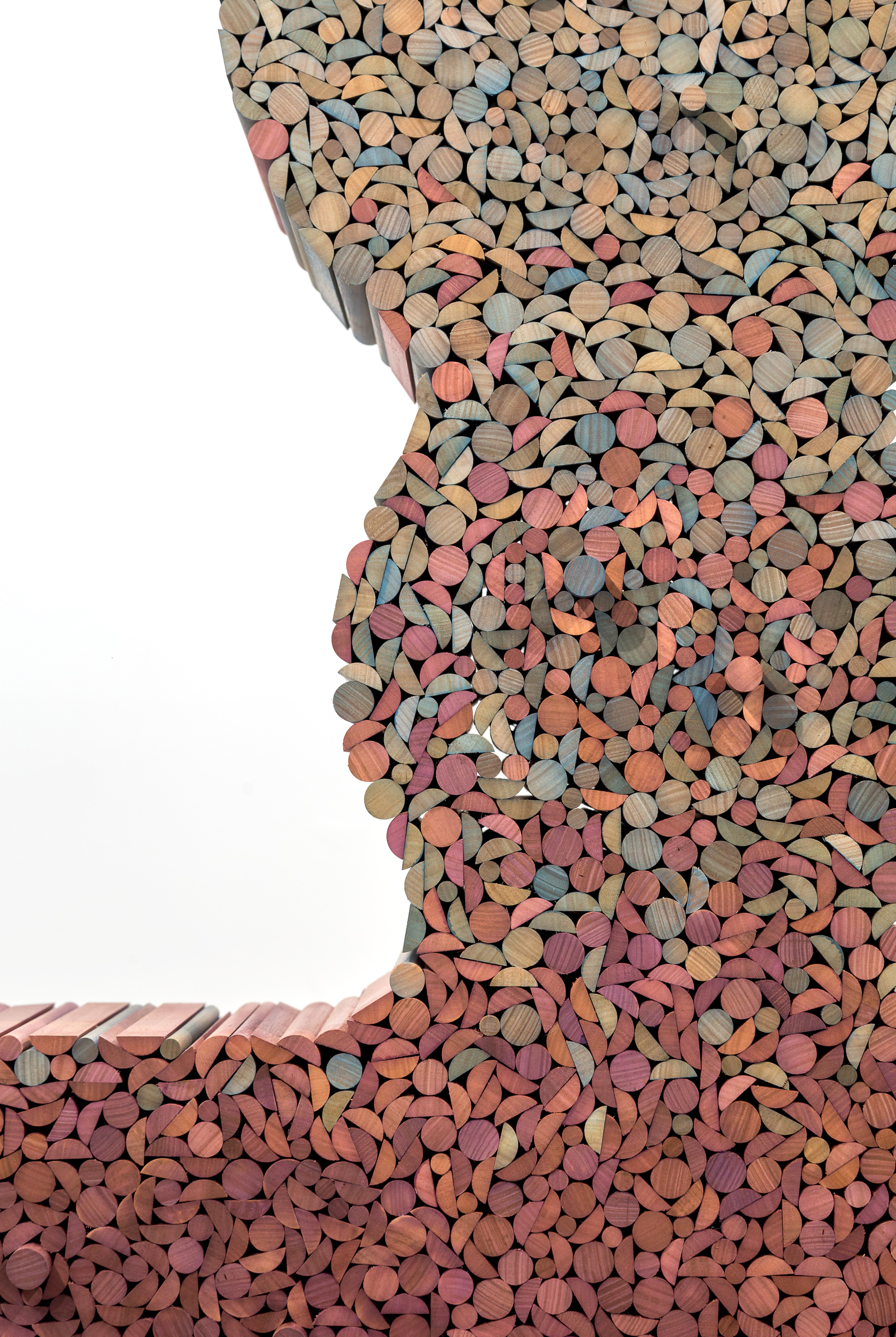
Figure 1. Tassie Oak, 2018.

One of Rich’s artworks, ‘Tassie Oak’ (2018), is a large sculptural piece of a drawer embedded with pink and teal gradients; resembling the shades of a sunset (see Figure 1). Rich found her inspiration for the artwork when she was camping by a dry river, and began collecting small piles of dried leaves that became a gradient of yellows and pinks (Elliat Rich, 2018). Her artwork also symbolises the curves of the rocky boulders visible in the dry lands of Australia, and the movement of walking on a path through the outback. The wood chips used to create the sculpture represent the colours of the sandy sky at dusk and their raw texture connects to the native flora and fauna (see Figure 2).  

As an Australian artist herself, Rich focuses heavily on what it means to create Australian design and how to respectfully use inspiration from her homeland. In her artwork, Tassie Oak (2018), Rich relates to the idea of personal experience, particularly her connection with her home in central Australia. She aims to create a story for the viewers by subtly connecting a time and place to each artwork, which is constructed through the decision of certain colour palettes or the use of natural materials like wood. Tassie Oak, in particular, tells a specific story about rural Alice Springs and what objects she would use if she had to describe her home to the audience. Rich also discusses what she has learnt from living hours away from the city; how she has had the opportunity to experience true Indigenous heritage and culture, and the diverse ways of living in the world when distant from suburbia (Philippa Barr, 2018).

Figure 2. Boulders and sunset in Alice Springs.

During Week 2, we explored the topic of decolonisation and Australian Indigenous design. Decolonisation is a way for non-Indigenous Australians to acknowledge the damage caused upon Aboriginal and Torres Strait Islander people through colonialism. In Tassie Oak, Rich stated that the sunset hues represent the beautiful landscape, but also teaches us to understand the kind of stories that have grown out of it and how alive it is (Philippa Barr, 2018). Her work does not exploit or manipulate the idea of rural Australia, but instead Rich carefully selects objects and symbols that will successfully maintain its story. The artwork is an insight into how we should respectfully celebrate the right people and landmarks in Australian history, and learn to somewhat deprioritise the white Westernised heroes. Rich uses her work as a powerful example for leadership when envisioning what a decolonised Australia could be.

Rich is well-known in the art world for her devotion to equality. She associates all her projects with the motive to promote equality and ethicality between all people of any class, gender and culture (Elliat Rich, 2018). When it comes to equality, an issue the exhibition may obtain is the debate that women are being acknowledged for their work simply because they are women; not because they are designers. Universally, both men and women designers want to be recognised purely for their work and not their gender identity (Simone Leamon, 2018). However, we could also change this argument and discuss why we are now creating a platform for merely women designers in an exhibition space today. In relation to the Week 4 topic of Australian Graphic Design, we explored how history has influenced the need to fix social concerns and discrimination in design. Throughout the 20th century, very few design collectives, such as Redback Graphix, focused on socially concerned design and the need for change through public protests and posters. (Redback Graphix, 1989). This did successfully create a voice for these gender concerns, but the overriding power of white male culture made it a slow process. Today, our design culture has evolved and allows us to acknowledge Australian artists like Rich who is a voice for gender equality and Australian design. If we look at the work of contemporary women designers in this exhibition we can draw attention to design’s evolving history – and its role in shaping today’s society Simone Leamon (2018).

Tassie Oak is merely a sculptural piece; it is a window into a conversation about creating respectful Australian Indigenous design and acknowledging the history and home of those affected. Although it was many years later, the NGV exhibition allowed Rich to use her platform to spread awareness about the power of home and sourcing inspiration respectfully.

References

Figure 1. Elliat Rich, Tassie Oak sculpture, NGV, 2018.

Figure 2. Rainbow Valley Sunset, Wiz Tours. https://www.wiztours.com/tour/rainbow-valley-sunset-supper-tour-from-alice-springs-31656.html

Simone Leamon, Designing Women, NGV, 2018. https://www.ngv.vic.gov.au/exhibition/designing-women/

Elliat Rich, Other Places – Drawers, Elliat, 2018. http://www.elliatrich.com/other-places

Philippa Barr, Australia. A profile of Elliat Rich, Domus, 10th August 2018. https://www.domusweb.it/en/design/2018/08/10/australia-a-profile-of-elliat-rich.html

Graphix, Redback. 1989. Redback Graphix: Now we are 10, a retrospective 1979-1989, (The Impressionists 1989), 4-8.
What’s So New About Bamboo

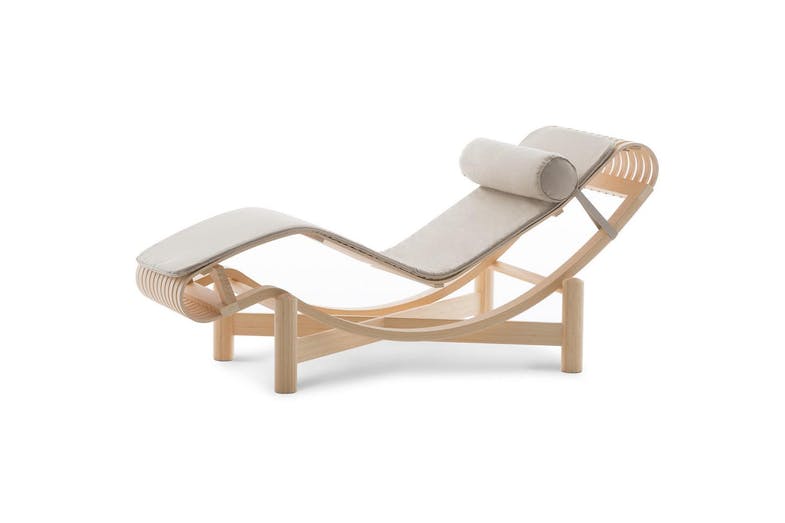
Charlotte Perriand was a furniture designer and a voice for female artists shaping modern living in the 20th century. Born in 1903 in Paris, France, Perriand’s particular style was rebellious, as she insisted on moving towards machine-age technology rather than following traditions (Catherine Anderson, 2016). In the 1930’s, the furniture designer and architect was asked to increase the flow of Japanese products to the West, whilst also challenging the current styles among Japanese artists, designers, and architects. Through this research, Perriand designed the ‘522 Tokyo Chaise Lounge’ in 1940, made from a solid wood frame of bamboo sourced from Japan (see Figure 1). The seat is composed into twelve wooden curves, with the strips and bars joined by satin brass studs. This idea replaced the traditional method of steel-tubing that the Western designers were still using to construct furniture and appliances (Cassina Page, 2014). She turned the traditional bamboo processing technique into a modern piece of furniture, whilst also using and respecting the natural materials to their full extent. Perriand’s design was remarkably modern that you could easily assume it was produced on a larger scale just a few years ago.

Figure 1. 522 Tokyo Chaise Lounge.

The Tokyo Chaise Lounge aims to challenge the way designers used new materials, and making sure it was in a respectful and creditable manner to their source, whilst also creating a positive response – rather than critical – towards its origin. Prior to outsourcing the bamboo from Japan, Perriand researched the design culture over the span of five years, and spent her time exploring the possible uses that a versatile material like bamboo could have (Catherine Anderson, 2016). Subtly, she acknowledged its origin by naming the furniture ‘Tokyo’ Chaise Lounge, which creates a connection between the product and the culture for new consumers. Perriand also hoped the design of the 522 Tokyo Chaise Lounge would ignite conversations throughout the Western society, primarily about the possibilities and benefits of sourcing materials from around the world with the hopes of improving design in society.

Perriand was also particularly aware of the suffering in the world during the 1950’s, and knew that design could play a vital role in the discovery of solutions to create a fair society. The Chaise Lounge design is a great example of this, as Perriand did not rely on the cultural stereotypes from Japan to showcase or sell her design to the public. In relation to the Week 4 class discussion of design culture, Perriand could have easily used the Japanese art, food, or even the popular Kawaii style to influence her art and make it easier to understand to the white Western culture (Dimeji Onafuwa, 2018). However, she mindfully focused on the bamboo being environmentally friendly, undervalued and its popularity across the locals. If the design had been in the hands of a different designer, we could argue that exporting traditional resources to the Western culture could have potentially exploited how special and versatile it is, due to the substantial difference in cultures and the growing consumer demand happening in America at the time.  

Perriand was confident in her skill of combining traditional and modern, which can be proven through the positive response of her furniture designs. However, an issue that arose was the functionality of the 522 Tokyo Chaise Lounge. Aside from its beauty and thorough design, people in Japan believed it may not suitable for mass production internationally, despite its practical use as outdoor furniture (Catherine Anderson, 2016). The Week 1 reading, Design Studies: Tasks and Challenges, discusses the idea that art and design are two separate entities, and they should follow a different set of rules (Victor Margolin, 2013). Artworks no matter what form they take, are not expected to produce a result or be a certain form, yet in design an expected outcome should be achieved. Perriand was a furniture designer, but did not necessarily focus on the mass production opportunities or how affordable she could make it. It was special, influenced by her travels and carefully thought out. The problem here is that both art and design were crossing paths in Perriand’s design, even though Margolin states that design should always have a purpose, a reason, and a problem to solve. The design culture in the 1950’s saw products having a higher turnover and a demand for more, which explains the one problem towards the availability of Perriand’s Chaise Lounge.

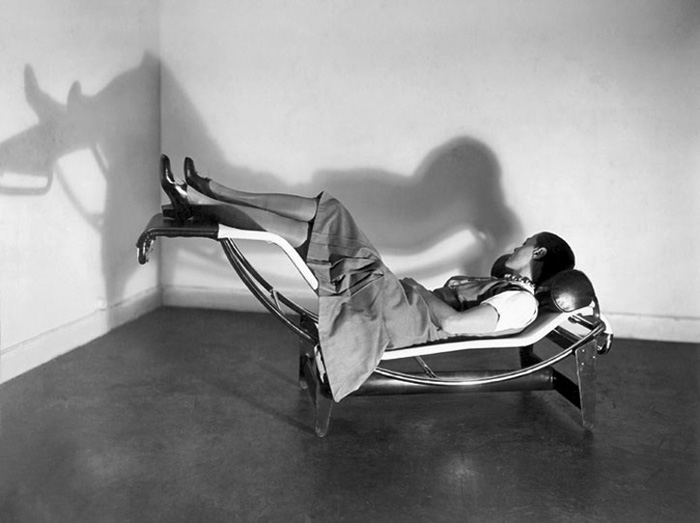
Figure 2. Charlotte Perriand on B306 Chaise Lounge.

Besides the design, the advertising for the 522 Tokyo Chaise Lounge was heavily aimed at the feminine women and her physical appeal (see Figure 2). The idea was to photograph Perriand herself and other women draped across the lounge, with the intention of communicating modernity and femininity to the public. It could also be argued that sexualised women were used during the advertising to sell the product to the public. Perriand was unaware of the reaction her design may cause in the public eye from using a new outsourced material, so the idea to promote the product through the female gaze may have been a possibility.

One issue that is identified in Perriand’s work throughout her career is that they were not so heavily credited for. When she collaborated with Le Corbusier, he was often given sole credit for the conception and designs for the Chaise Lounges (Catherine Anderson, 2016). However, Perriand acknowledged that he had defined the framework of the overall forms of the chairs, but she had initiated the details, construction, and actual design. This issue can be related back to the discussion in Week 2, where Australian Indigenous design and cultural identity was explored. Commonly, the authorisation of artworks not being recognised can cause consumers to only remember the object but disregard the designers behind it. The entire meaning of the artwork can also be changed when it is not identified to its rightful owner (Dimeji Onafuwa, 2018). The risk of not acknowledging the appropriate artist is that it adds to the assumption that men in a white Western culture have created iconic designs throughout history, whilst proving the bias towards the women.

Perriand and her furniture design has pushed the idea of combining traditional with modern successfully, proving there is a way to promote new ideas without exploiting cultures and stereotypes. The issues that arose throughout her designs did not come from Perriand’s lack of research, but from a close-minded Western culture who may have not understood Perriand’s modernist style. She was always known to other designers for her research into the future, accepting change, and knowing when to experiment and when to just be respectful.

References

Figure 1. Charlotte Perriand, 522 Tokyo Chaise Lounge, Space Lounge, Cassina. https://www.spacefurniture.com.au/522-tokyo-chaise-longue.html

Figure 2. Charlotte Perriand, B306 Chaise Lounge, Renzoe Box. https://www.renzoebox.com/renzoeblog/charlotte-perriand

Catherine Anderson, Charlotte Perriand, Encyclopedia Britannica, 4th January 2016. https://www.britannica.com/biography/Charlotte-Perriand

I Maestri, Charlotte Perriand, Cassina, 2014. https://www.cassina.com/en/designer/charlotte-perriand

Virtual Culture, The Structure of a Japanese House, Kids Web Japan. https://web-japan.org/kidsweb/virtual/house/house01.html

Onafuwa, Dimeji. 2018. Allies and Decoloniality: A Review of the Intersectional Perspectives on Design, Politics, and Power Symposium, design and culture, (2018), 10-11.

Margolin, Victor. 2013. Design Studies: Tasks and Challenges, The Design Journal, (Bloomsbury Publishing PLC 2013), 400-407.