In today’s society, many designers are remembered by the world, such as Le Corbusier (1887 — 1965), Marcel Breuer (1902 — 1981), Massimo Vignelli (1931 — 2014), etc. They are all famous designers. However, in my researchof famous designers, I found thatalmost is mandesigners, just have several female designers are remembered.Why is this happening? What causes it? Why are female designers forgotten? I wrote this blog about these questions.
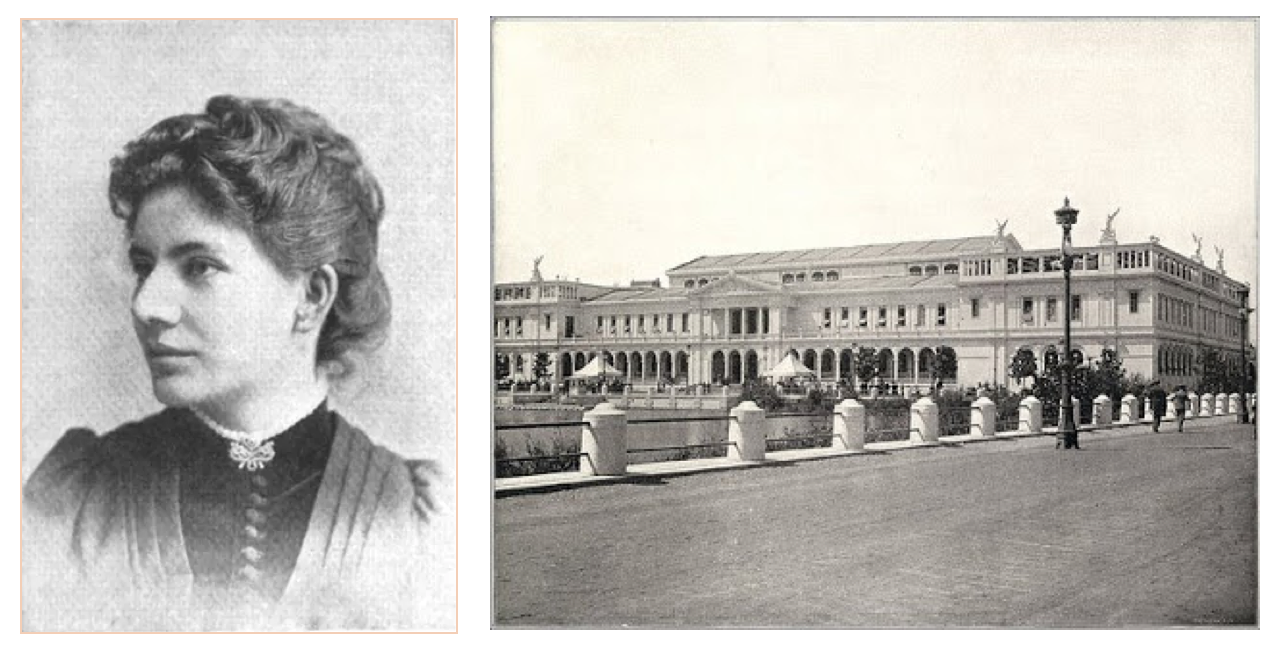
Figure 1 is Sophia Hayden.
Figure 2 is Woman’s Building. World’s Columbian Exposition (1892: Chicago, Ill.).
After my research, I found that a female designer named Sophia Hayden, her ability is very strong, but she was forgotten by the world. Sophia Hayden (1868 — 1953) was an American architect and the first female graduate of a four-year program in architecture at the Massachusetts institute of technology (Wikipedia, 2019). And Hayden won the national competition to design the Woman’s Building for the 1893 World’s Columbian Exposition (Remembering Sophia Hayden, architect of the Woman’s Building, 2018). After Hayden graduated, she accepted a job as a mechanical drawing teacher at a high school in Boston because she was a woman and might have trouble finding an entry-level apprenticeship (Wikipedia, 2019). After a series of sexism, she became frustrated with the unfairness and broke down. She decided to retire from architecture (or maybe not), but she stopped being an architect. In 1894, she designed a Memorial Building for the Women’s Clubs of America, but it was never constructed. She later married artist William Bennett, and her name slipped into obscurity. When she died in 1953, Bennett died at the Winthrop Convalescent Nursing Home in 1953, her obituary did not even note her accomplishment (Remembering Sophia Hayden, architect of the Woman’s Building, 2018).
In her life, she graduated from MIT in 1890 with a degree in architecture, with honors. However, graduated in architecture was difficult to find work as a woman architect, so she accepted a position as a technical drawing teacher at a school in Boston. It was the first time she had experienced sexism, this shows that woman is not treated fairly when they look for jobs. In 1891, she saw a notice inviting female architects to take part in a competition. This is a women’s building for the world’s Columbian exposition, and this project is significant because women plan every aspect of the building. Hayden won the competition, she was number one in this competition, and she designed a three-story white building, the building including pavilions at the center and end, multiple arches and columned terraces. The classical features of the building in the style of the Italian Renaissance. She was paid only $1,000 for her designs, while some male architects earned $10,000 for similar buildings. This is the second time she has been subjected to sexism,this shows women are not treated fairly regardingpay. Hayden’s architecture won for its “exquisite style, artistic taste, and intimate and elegant interior lobby.” However, despite her gold medal from the women’s governing council, male commentators have been rather arrogant, claiming the structure has “feminine” qualities such as elegance and grace. This is the third time she has been subjected to sexism, this shows women are not treated fairly regardingdesign. Rumours that she had a nervous breakdown was taken as evidence that women were unfit to work in construction. After the fair, the women’s pavilion was demolished, and Hayden, frustrated with how he had been treated, quit architecture. In her career, the Woman’s Building is the only one Hayden has ever designed.
Regardinggender discrimination, I have read a book called Design and Culture: The Journal of The Design Studies Forum, in which men can actually determine women’s aesthetic taste. They believe that the women have white skin are good-looking, which leads to the fact that women all over the world want white skin. During Sophia Hayden’s career,her works were always restricted by men, which led to many ideas that could not be realized, causing a heavy blow to her body and soul. Therefore, she decided not to design architecture and quit the industry. So much so that she was marginalized by society, and even her only architectural work was demolished, and there was no trace of her design in this world.
After the above detailed analysis of Sophia Hayden, I came to a conclusion. The reason why mostly famous designers are male designers is that there was discrimination against women in the early society, which led to the oppression of many talented female designers and their inability to show their strength, which resulted in their marginalization and made their information inaccessible to the present audience. Sophia Hayden is a typical example. After being oppressed, she chose to quit the construction industry with her outstanding ability, which makes it a pity that another excellent work is missing in the history of design.
I think society values men and treats women with sexism. This may be because men are in the dominant position in the society and family, while women tend to be treated unfairly due to their disadvantage. I hope there will be no more sexism in our society. Men and women are equal, and they do or perform the same duties in the society, we need to equal employment opportunities, equal wages, equal treatment of design outcomes and so on.
References:
En.wikipedia.org. (2019). Sophia Hayden. [online] Available at: https://en.wikipedia.org/wiki/Sophia_Hayden [Accessed 11 Apr. 2019].
Blumberg, N. (2019). Sophia Hayden | American architect. [online] Encyclopedia Britannica. Available at: https://www.britannica.com/biography/Sophia-Hayden [Accessed 11 Apr. 2019].
Onafuwa, D. (2018). Allies and Decoloniality: A Review of the Intersectional Perspectives on Design, Politics, and Power Symposium. Design and Culture, 10(1), pp.7-15.
Chicago’s 1893 World’s Fair. (2018). Remembering Sophia Hayden, architect of the Woman’s Building – Chicago’s 1893 World’s Fair. [online] Available at: https://worldsfairchicago1893.com/2018/10/17/sophia-hayden/ [Accessed 11 Apr. 2019].

 Design Research