“Designing Women” is the National Gallery of Victoria’s exhibition highlighting contemporary female designers. It showcases over 50 key works from 1980-2018 featuring fashion design, architecture, industrial design, digital design, ceramics and jewellery design (NGV 2018). The purpose of the exhibition was to shine a light on the achievements of female designers and the role they play in pushing design forward in innovative and inspiring ways.
I visited the exhibition and was impressed by the diversity of the collection and the range of pieces. The exhibition is grouped into four key narratives: leadership, community, teamwork and research. While reading the explanations for these themes and the gallery notes beside each piece I was encouraged to think about women’s historical and cultural role in design. I was being led to view each piece in direct relation to the gender of its designer. This is of course expected as it is an exhibition that focuses on women. However it is interesting how many different things can be said about these pieces that go beyond gender.
Kirkham and Attfield in their anthology of essays “The Gendered Object” encourage that we look beyond an object as simply a physical thing but rather think of it in terms of human experience (Kirkham and Attfield 1996, 1-11). How we interact with it, how we use and how it makes us feel (Kirkham and Attfield 1996, 1-11). To look at the sum of its parts we should consider an object through every possible lens. This includes looking through the lens of historical and cultural context, lens of philosophy, psychology, feminism, sexuality and more (Kirkham and Attfield 1996, 1-11). When attending an exhibition that largely focuses on one lens it highlights that approach and can often result in the other considerations being forgotten. I believe that while it is a wonderful thing the NGV has done by exhibiting the work of female designers who are often overlooked in our patriarchal society it can result in the works being seen as “female” or “feminine” which runs the risk of reducing a piece to just one of its possible interpretations. When viewing the works on display at Designing Women I would encourage that the audience should think beyond gender for each piece. These are not “female” designs these are designs created by designers who happen to be women. And these designers have not created every piece to be a statement on their womanhood. Of course design once out of the designers hand should be free to be interpreted any way its viewer sees fit but I would encourage the viewers of this exhibition to really try to fully ponder the possible nuances and all the interpretations of each piece.
The piece that intrigued me the most was Horse Lamp (see figure 1 and 2), it immediately triggered a strong emotional response from me that took some time to unpack and understand what it was I was feeling. Horse Lamp 2006, is a true to scale sculptor of a horse with a cylindrical functioning lamp attachment sprouting from its head. The design was created by Stockholm based group Front Design, including designers Sofia Lagerkvist, Anna Lindgren, Charlotte von der Lancken and Katja Sävström. If you had forgotten the true size of a horse this lamp will remind you that they are very large indeed. The horse dwarfs the attached lampshade and everything around it. It was a popular product that sold well and has been featured in many exhibitions (Hobson 2016). As such it has been viewed by many people and interpreted in many different ways. Many that I’m sure Front Design never would have imagined. I believe that to truly understand this piece we must adopt Kirkham’s and Attfield’s multifaceted approach and analyse all possible meanings and themes. We must not let the focus of the exhibition be our only interpretation or we are in danger of reducing these works to the single dimension of gender.
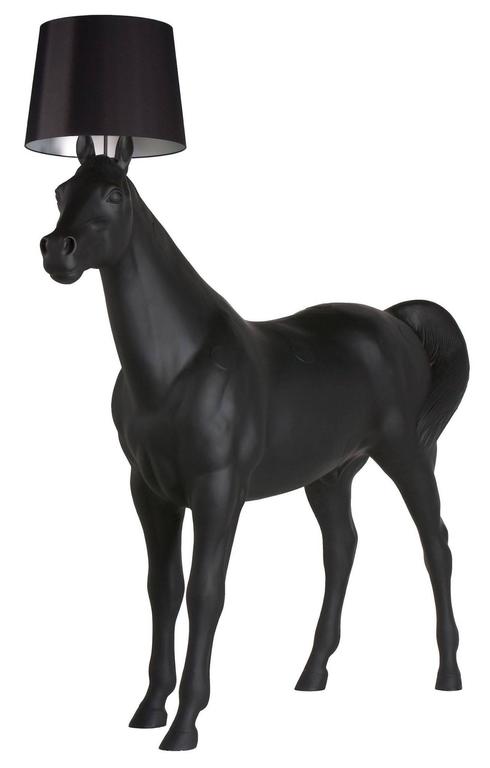
PVC plastic, polycarbonate, steel, viscose,
E27 bulb and electricals. Accessed 12 April, 2019. https://www.1stdibs.com/furniture/lighting/floor-lamps/moooi-horse-lamp-front-design/id-f_7640833/.
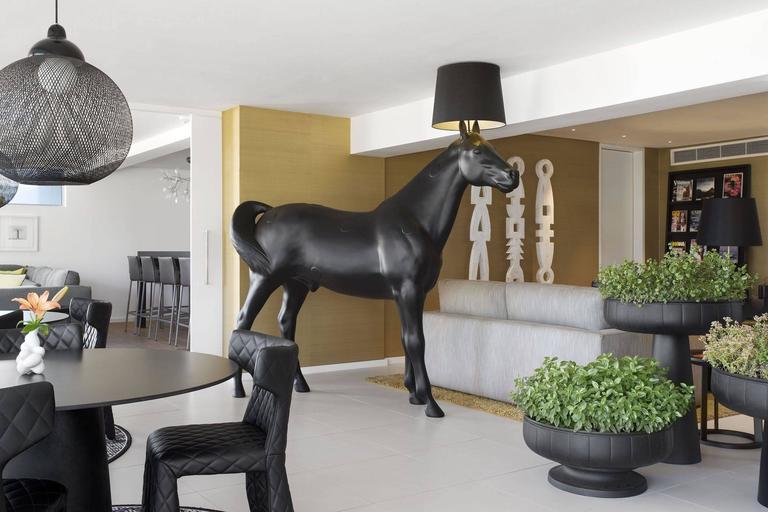
PVC plastic, polycarbonate, steel, viscose,
E27 bulb and electricals. Accessed 12 April, 2019.
https://www.1stdibs.com/furniture/lighting/floor-lamps/moooi-horse-lamp-front-design/id-f_7640833/.
With an exhibition focused on female designers it is easy to think of each piece through the lens of gender. To think of feminist theory and “was does this piece say?” in relation to that field. It is important that we do think about that. Horse Lamp in this context could easily be viewed as a feminist piece. This lamp struck me as having a very male energy. The work is made of a PVC viscose laminate shade, a metal frame structure and polyester horse. Metal and plastics are often viewed as “male” materials whereas wood and clay are seen as “female”. It was large, dark and imposing, qualities that are traditionally associated with masculinity. And yet it is a lamp with no gender. If I was to view this through a feminist lens I would say that women are traditionally taught to not take up too much space, to shrink themselves, to be smaller and quieter. This lamp is none of those things. Its enormity is overwhelming, it cannot help but draw attention to itself. The black of it frame is bold and dark, the complete opposite of what is expected from a female designer.
Had this piece been in an exhibition with a different focus I’m sure I would have interpreted it differently. Had this horse lamp been in an exhibition showing off the best of modern Scandinavian design my thoughts perhaps would have been on its rejection of minimalism and functionality. The typical characteristics of Scandinavian design being light muted colours, wide spaces and simplified functional forms (Contemporist 2016). Scandinavian interiors uses minimal décor and furniture to create a bright, cohesive and open feeling to a room (Lakzy 2018). Maximising the amount of space and minimising clutter (Smith Brother Construction 2016). Focusing on furniture that is functional without drawing attention to itself is best (Lakzy 2018). Traditionally industrial designers are trained to design objects that perform specific tasks. The shape, form and size of an object is designed to make that task easy (NGV 2018). Lamps would traditionally be designed to be small, non-intrusive and not take up too much space. This lamp is different, its enormous form fills the room and reminds every one of its presence. The black looming quality it possess won’t let it be forgotten and make it difficult to cohesively work into a room. Front Design by creating a piece so absurd and out-of-place seem to laugh at the serious, uniform design culture surrounding them in Stockholm. They instead encourage us to break free and laugh with them. Laugh at the visual of a horse with a lamp on its head. Their experimental design is pushing us to move forward, past our expectations of what new design coming out of Scandinavia should looks like.
In an exhibition focused on nature the focus could have been on Horse Lamps use of an animal as the base of the lamp. Possibly a reminder that we are so disconnected from nature that the true size of a horse is shocking to us. Or a critic of how we think about animals. We often only think of animals as existing for our use, for us to eat, to experiment on, to put to work (Grover 2011). Even in a kinder scenario we use them as pets, we treat them as our possessions rather than autonomous beings. The horse for hundreds of years has been used by humans. Horses ploughed our fields, pulled our carriages, charged with us into war, carried us around, we even use them for sport (Grover 2011). Here a horse, a creature that once widely roamed the fields, is turned into furniture. This could be symbolic of our relationship with horses. Our treatment of them as servants turns them from a living being into an unfeeling object that like furniture exists simply for our use.
Everybody interpretation of design will be different and each of these interpretations is valid. It is important that we don’t forget how complex the world we live in is and how our different experiences will shape how we see, interact with and understand an object. Exhibitions encourages us to focus on one way of seeing. This can be a very important tool as it is with NGV’s “Designing Women” as a female perceptive is often forgotten but it is not and should not be the only way. I encourage you to go and see this exhibition, celebrate female designers but do not forget that they are also just designers whose works span many themes and each of these themes should be remembered.
References
Contemporist. 2016. 10 Common Features Of Scandinavian Interior Design. Contemporist. July 14. Accessed April 13, 2019. http://www.contemporist.com/10-common-features-of-scandinavian-interior-design/.
Front Design. 2006. Horse Lamp. PVC plastic, polycarbonate, steel, viscose, E27 bulb and electricals. Accessed 12 April, 2019. https://www.1stdibs.com/furniture/lighting/floor-lamps/moooi-horse-lamp-front-design/id-f_7640833/.
Sami Grover. 2011. Are Working Animals our Partners or our Slaves. Tree Hugger. October 27. Accessed April 14, 2019. https://www.treehugger.com/culture/are-working-animals-our-partners-or-our-slaves.html.
Hansgrophe. Front Design – the Swedish “Avant-gardistes”. Accessed April 13, 2019. http://www.hansgrohe.com.au/21309.htm.
Ben Hobson. 2016. Front’s Lifesize Horse Lamp for Moooi was a Provocative Experiment. Dezeen. August 17. Accessed April 13, 2019. https://www.dezeen.com/2016/08/17/video-interview-front-lifesize-horse-lamp-animal-collection-moooi-experiment-movie/
Kirkham, Patt and Judy Attfield. 1996. The Gendered Object. Manchester: Manchester University Press.
Mary Lakzy, blog. 2017. 8 Basics of Scandinavian Style Interior Design. Comelite Archirecture. April 14. Accessed April 15, 2019. https://comelite-arch.com/blog/scandinavian-style-interior-design/.
NGV. 2018. Designing Women: Artwork Labels. Accessed April 11, 2019. https://www.ngv.vic.gov.au/wp-content/uploads/2018/10/Designing-Women_Large-print-labels.pdf.
NGV. 2018. Designing Women: Modern-Day Trailblazers Defining the Future Through Design. NGV. Accessed April 11, 2019. https://www.ngv.vic.gov.au/exhibition/designing-women/.
Smith Brothers Construction. 2016. The Philosophy of Scandinavian Design. Smith Brothers Construction. May 5. Accessed April 15, 2019. https://smithbrothersconstruction.com/the-philosophy-of-scandinavian-design/.

 Design Research