The idea of visibility for women in design and how we celebrate their creativity and innovation was explored through the Designing Women Exhibition at the NGV. For centuries, women in design have been invisible and unrecognised for their work, in comparison to male artists and designers. The exhibition aimed to change this, and instead celebrated the artworks but also the history and achievements of women. From the fifty female artists showcased at the NGV, I took a heavy interest in Elliat Rich, an artist and furniture designer who moved to remote Alice Springs in 2004.
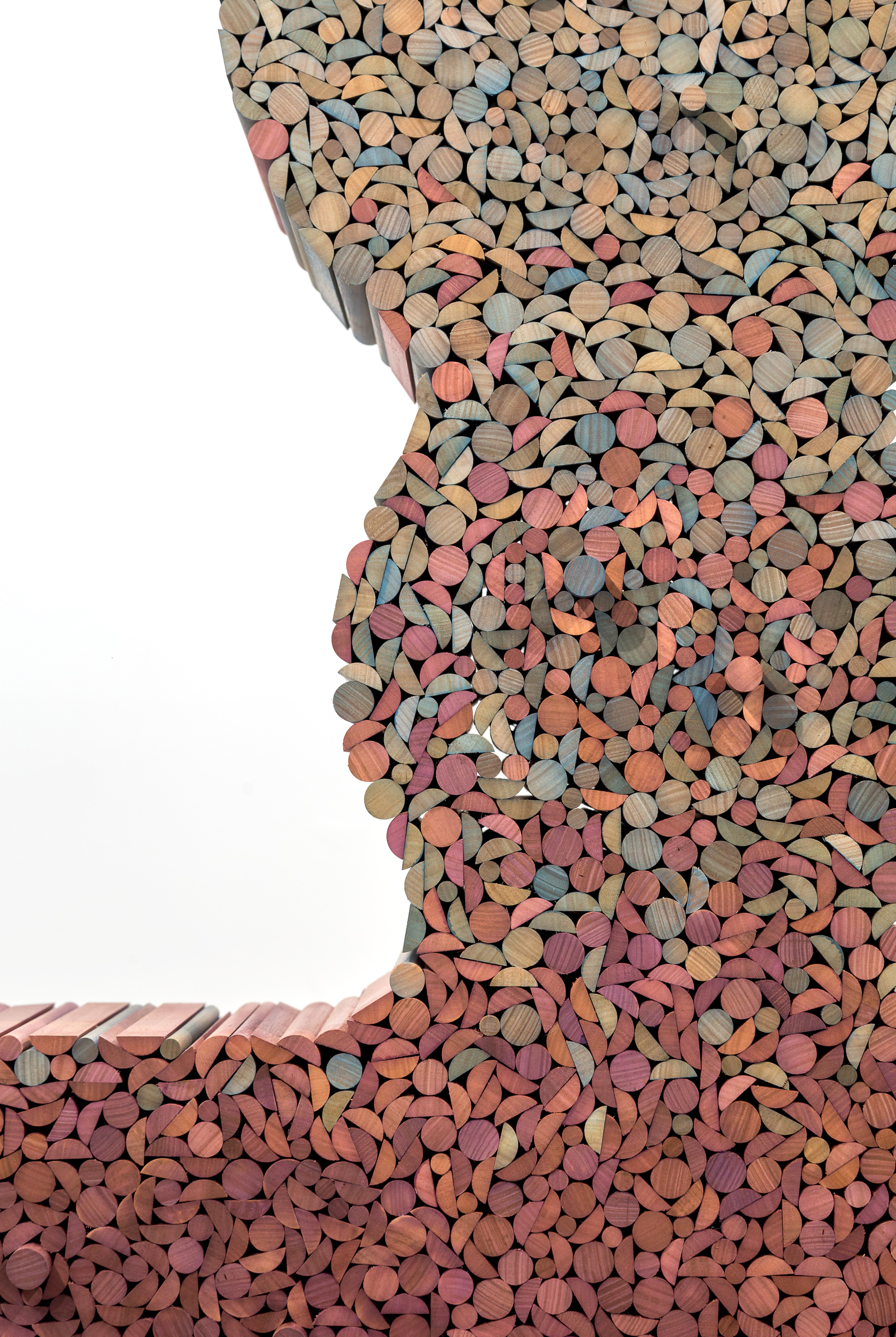
One of Rich’s artworks, ‘Tassie Oak’ (2018), is a large sculptural piece of a drawer embedded with pink and teal gradients; resembling the shades of a sunset (see Figure 1). Rich found her inspiration for the artwork when she was camping by a dry river, and began collecting small piles of dried leaves that became a gradient of yellows and pinks (Elliat Rich, 2018). Her artwork also symbolises the curves of the rocky boulders visible in the dry lands of Australia, and the movement of walking on a path through the outback. The wood chips used to create the sculpture represent the colours of the sandy sky at dusk and their raw texture connects to the native flora and fauna (see Figure 2).
As an Australian artist herself, Rich focuses heavily on what it means to create Australian design and how to respectfully use inspiration from her homeland. In her artwork, Tassie Oak (2018), Rich relates to the idea of personal experience, particularly her connection with her home in central Australia. She aims to create a story for the viewers by subtly connecting a time and place to each artwork, which is constructed through the decision of certain colour palettes or the use of natural materials like wood. Tassie Oak, in particular, tells a specific story about rural Alice Springs and what objects she would use if she had to describe her home to the audience. Rich also discusses what she has learnt from living hours away from the city; how she has had the opportunity to experience true Indigenous heritage and culture, and the diverse ways of living in the world when distant from suburbia (Philippa Barr, 2018).

During Week 2, we explored the topic of decolonisation and Australian Indigenous design. Decolonisation is a way for non-Indigenous Australians to acknowledge the damage caused upon Aboriginal and Torres Strait Islander people through colonialism. In Tassie Oak, Rich stated that the sunset hues represent the beautiful landscape, but also teaches us to understand the kind of stories that have grown out of it and how alive it is (Philippa Barr, 2018). Her work does not exploit or manipulate the idea of rural Australia, but instead Rich carefully selects objects and symbols that will successfully maintain its story. The artwork is an insight into how we should respectfully celebrate the right people and landmarks in Australian history, and learn to somewhat deprioritise the white Westernised heroes. Rich uses her work as a powerful example for leadership when envisioning what a decolonised Australia could be.
Rich is well-known in the art world for her devotion to equality. She associates all her projects with the motive to promote equality and ethicality between all people of any class, gender and culture (Elliat Rich, 2018). When it comes to equality, an issue the exhibition may obtain is the debate that women are being acknowledged for their work simply because they are women; not because they are designers. Universally, both men and women designers want to be recognised purely for their work and not their gender identity (Simone Leamon, 2018). However, we could also change this argument and discuss why we are now creating a platform for merely women designers in an exhibition space today. In relation to the Week 4 topic of Australian Graphic Design, we explored how history has influenced the need to fix social concerns and discrimination in design. Throughout the 20th century, very few design collectives, such as Redback Graphix, focused on socially concerned design and the need for change through public protests and posters. (Redback Graphix, 1989). This did successfully create a voice for these gender concerns, but the overriding power of white male culture made it a slow process. Today, our design culture has evolved and allows us to acknowledge Australian artists like Rich who is a voice for gender equality and Australian design. If we look at the work of contemporary women designers in this exhibition we can draw attention to design’s evolving history – and its role in shaping today’s society Simone Leamon (2018).
Tassie Oak is merely a sculptural piece; it is a window into a conversation about creating respectful Australian Indigenous design and acknowledging the history and home of those affected. Although it was many years later, the NGV exhibition allowed Rich to use her platform to spread awareness about the power of home and sourcing inspiration respectfully.
References
Figure 1. Elliat Rich, Tassie Oak sculpture, NGV, 2018.
Figure 2. Rainbow Valley Sunset, Wiz Tours. https://www.wiztours.com/tour/rainbow-valley-sunset-supper-tour-from-alice-springs-31656.html
Simone Leamon, Designing Women, NGV, 2018. https://www.ngv.vic.gov.au/exhibition/designing-women/
Elliat Rich, Other Places – Drawers, Elliat, 2018. http://www.elliatrich.com/other-places
Philippa Barr, Australia. A profile of Elliat Rich, Domus, 10th August 2018. https://www.domusweb.it/en/design/2018/08/10/australia-a-profile-of-elliat-rich.html
Graphix, Redback. 1989. Redback Graphix: Now we are 10, a retrospective 1979-1989, (The Impressionists 1989), 4-8.

 Design Research