Currently showing at MUMA, is the knowledge-driven exhibition ‘Shapes of Knowledge’. Curated by Hannah Matthews, this exhibition features a diverse range of projects originating from Australia, Asia, Europe and Africa that invite the viewer to ponder how art and knowledge can inform each other and how it is shared. (MUMA, 2018)
The exhibition encompasses eight different projects that are quite different in their execution. Incorporating sculpture, audio, photography, video, clothing and print, the exhibition was an informative and sensory experience.
Upon entering the exhibition, the audience finds themselves in a room with an abundance of visual stimuli. All four walls are covered from top to bottom with a large print of a natural landscape that allow you to feel almost as if you’re in the middle of yolŋu country. Two of which depict a forest area, laden with green trees and grass, and a red dirt pathway in the centre. The other two walls portray a different landscape, this one being an ocean view, with soft gradient blues of the water which extend onto a collection of black rocks and then extend onto another area of greenery. In the centre of the room stands a display of seven screens all in a circle facing outwards and standing on a grey platform(fig.1). The displays all show different visuals such as video, video editing stills and sound editing programs, that the audience find out are part of ‘The Mulka Project’.
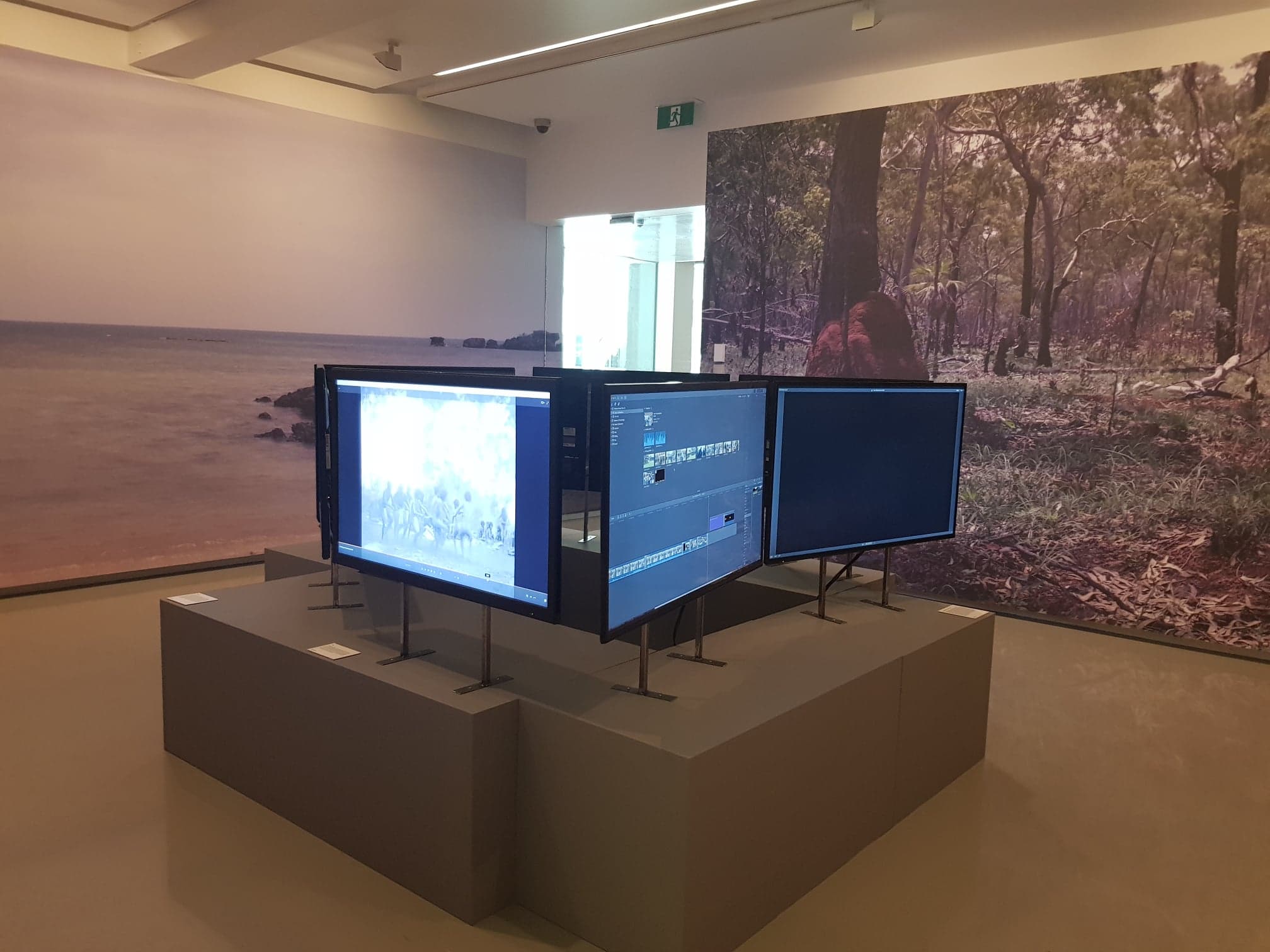
According to the description accompanying the room, ‘The Mulka Project’, is a “digital library and production centre located in Yirrkala in north-east Arnhem Land”. (MUMA, 2018) Since 2008, The Mulka Project has existed in order to support and document Yolŋu cultural knowledge and language, and operates out of the Buku-Larrnggay Mulka Centre under the guidance of members of the community.
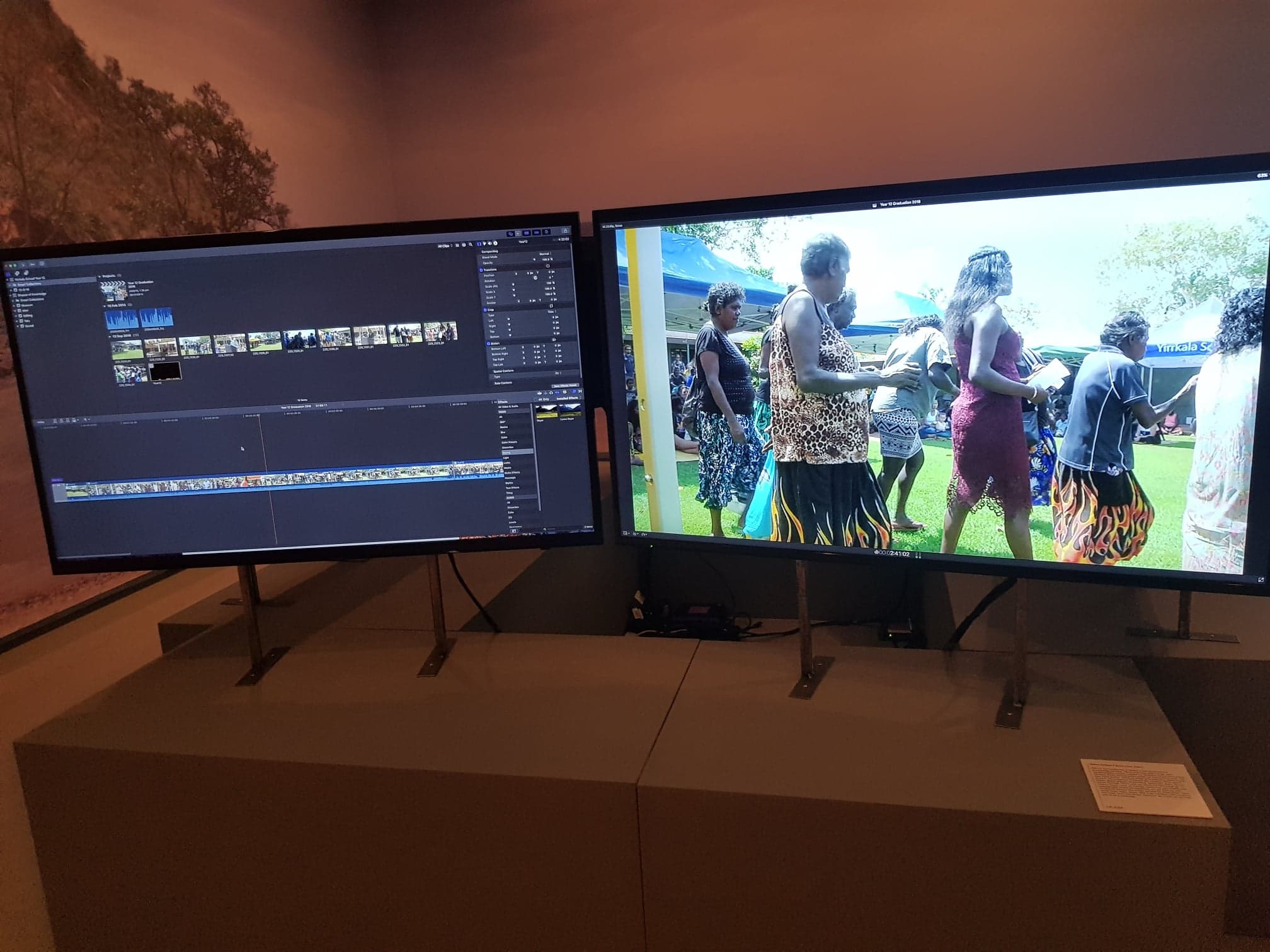
The first two screens I saw showed a video being played of a ceremony, next to another screen showing a screenshot of the videos in an editing program (fig.2). This signified the video making aspect of the project. Every year, Yolŋu filmmakers create over 100 new films which feature events such as bapurru ceremonies and films in the presence of senior law holders, as well as different aspects of their culture in general such as their food, art and dance. Importantly, there are films in the collection that have never been seen because they are waiting for senior elders to approve the films and allow them to go public with them.
This directly links to the Australian Indigenous Design Charter: Communication Design’s (AIDC:CD, 2016) number two point – “Self-determined. Respect for the rights of Indigenous peoples to oversee representation creation of their culture in design practice”(AIDC:CD,2016). In response to the Australian Government’s call for people to be more considerate when creating artwork that involves Australian Aboriginal and Torres Strait Islander people’s cultures and national identity, the AIDC:CD is a set of 10 protocols that designers are expected to follow when sharing Indigenous knowledge in their work. The AIDC:CD is extremely important because it holds all creatives in Australia to a high legal, ethical and professional standard and makes sure that Indigenous communities aren’t being exploited when they are being represented in artworks.
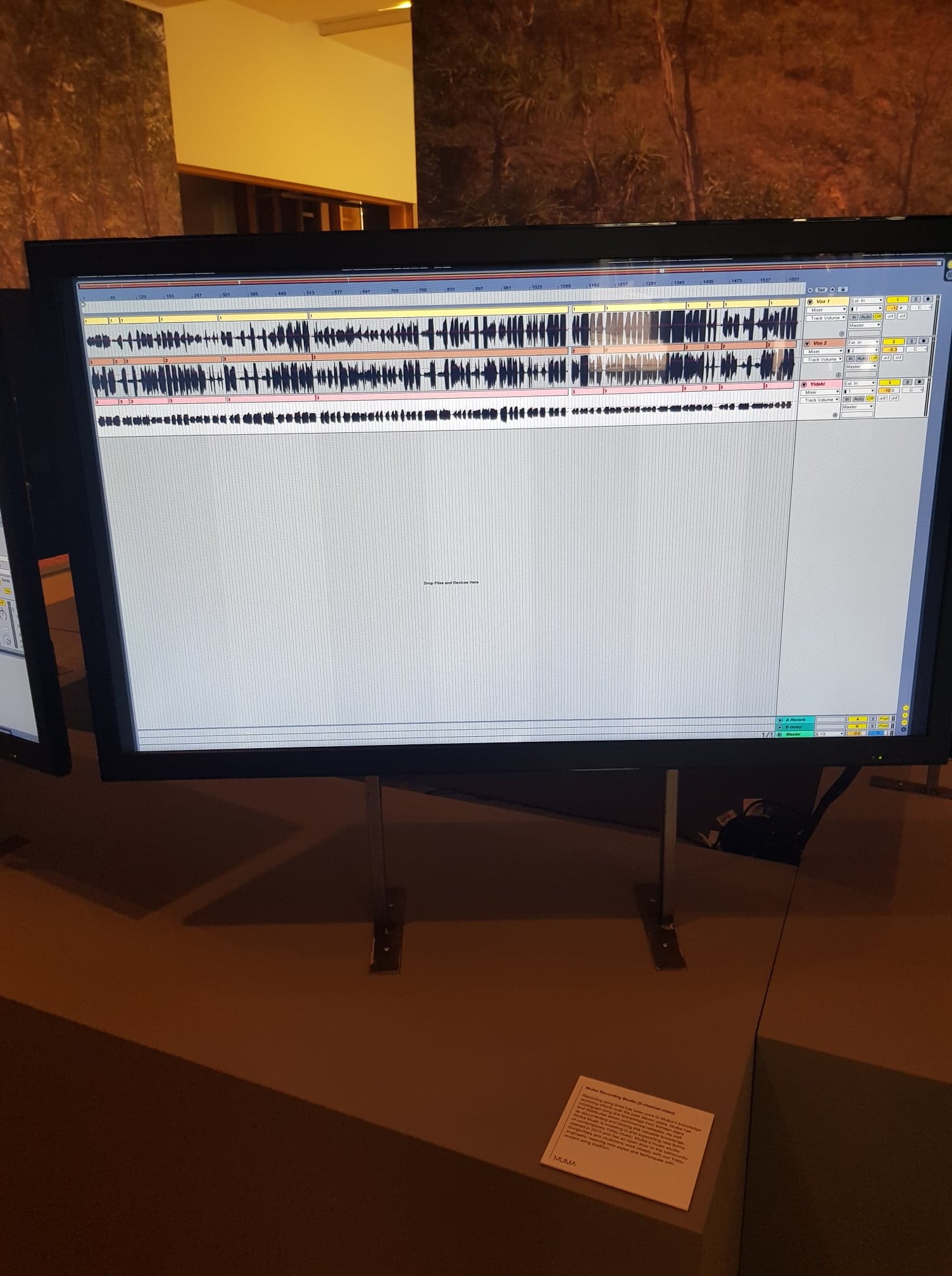
The next two screens I saw, featured what appeared to be sound waves on an editing program(fig.3). Upon reading the description, it became evident that it references how The Mulka Project has been archiving songs from thirteen clans to ensure that they aren’t forgotten in the future. According to the description, since 2015, the music studio has also allowed songwriters and musicians to work with Yolŋu sound engineers to create new styles of music that incorporate their traditional songs. This links to the AIDC:CD protocol number one point : “Indigenous led. Ensure Indigenous representation creation in design practice is Indigenous led.”(AIDC:CD, 2016) This is an important point because it makes sure that Indigenous people are at the forefront of the practice and have a big say in how much their traditional song is transformed with the newer modern techniques. I think it’s great because the Indigenous people are the only ones that will know where to draw the line when it comes to how much their traditional song can be altered before it becomes too much.
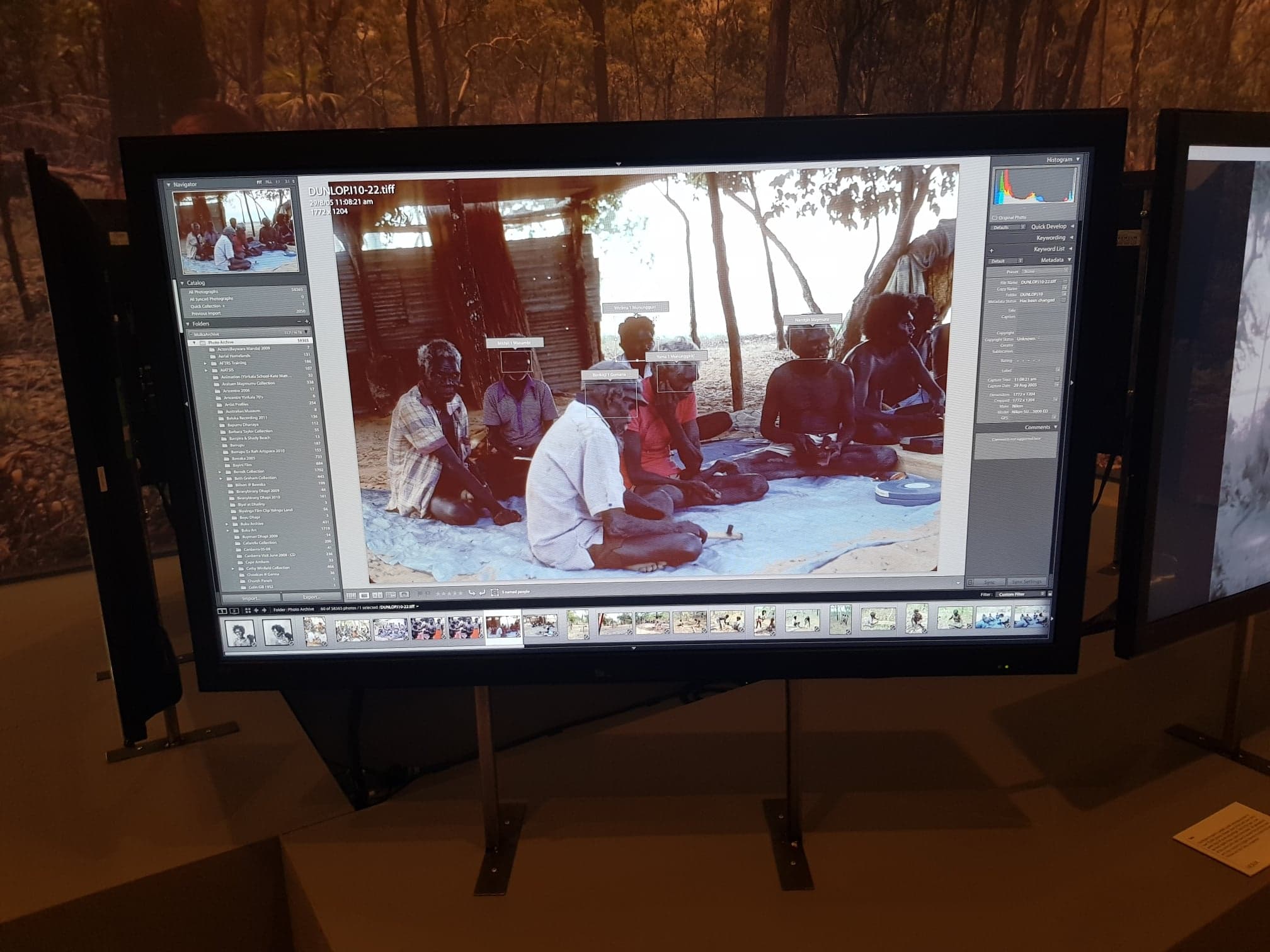
The next screens display a slideshow of traditional photos, as well as a glimpse into the editing software that uses facial recognition software so that everyone in the Yolŋu community can type in their name and find out who their ancestors are(fig.4). The Mulka Museum is home to over 400 bark paintings, sculptures, artefacts and a photographic archive that spans ninety years of ancestry. This relates to the AIDC:CD protocol number five point : “Impact of design. Always consider the reception and implications of all designs so that they are respectful to Indigenous culture” (AIDC:CD, 2016) I believe this point resonates with The Mulka Museum as the impact of it has been well considered and is actually a beneficial tool for the community to use.
Overall, this exhibition was mind-opening and caused me to think about new ideas. The Mulka Project was executed in a concise but clever way that easily depicted to the audience the decisions and techniques behind the project.
References
Indigenous Architecture and Design Victoria, Design Institute of Australia, Deakin University. “Australian Indigenous Design Charter – Communication Design(AIDC:CD)”, 2016.
MUMA, “Shapes of Knowledge Media Release”, 2018

 Design Research
I went the to exhibition I loved how the piece showed the process in which the video was created as that is always in the background or every art piece. It is really interesting that they did show the processes needed to create it and it allows the audience to appreciate the effort and time taken by the artist whilst creating it.
As discussed in the AIDC guide, it is important to not exploit the information that has been shared with us as non-indigenous people and it is crucial that we do not manipulate their views to coincide with our message, and I think that is a big job for someone who chooses to take on the challenge and edit the video without showing any form or prejudice toward the subjects in the video. And also outlined in the charter, and discussed in your writing, it is important to involve the indigenous when creating the piece and to ask for their input.
Overall I think it was a great piece of work that you have chosen to explore and the topics discussed in the AIDC charter was well integrated into your writing.
LikeLike