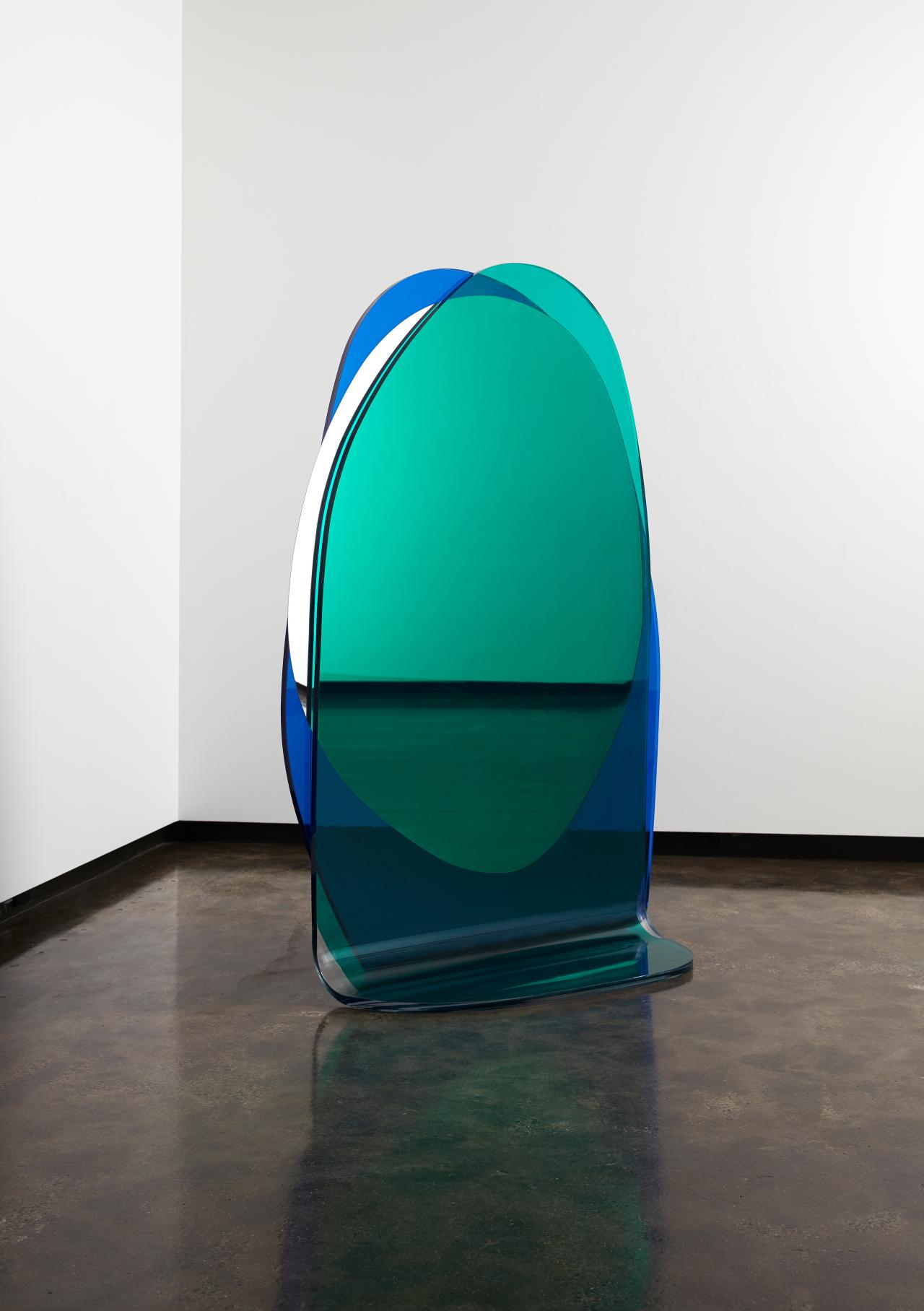
Standing Mirror is part of Elliat Rich’s Other Places series of limited furniture design. Rich evokes intuitive shift between experiences visions and materials which are achieved through the distance ranges. These result from the combination of dust, eucalyptus gas, light and any other magical element that lie between the audience and the masterpiece. Rich intends that the piece off-sets a conceptual underpinning that is filled with a sense of curiosity and joy. The unique color combination used provides a distinct taste which combines multiple hues. The elements used to enable Rich to derive both reality and illusion in a single set which results in the half-object and half reflection achieved.
According to women design, women get minimal recognition for their work and expose the barriers to the success of women in the industry which occur in the areas of socialization, education and the work environment. These aspects are relevant to the understanding of the piece. The pure element that makes up the artwork are in themselves not given prominence in the same way that the female artists who make up the foundation of the industry are not given prominence (Bruce, 1990). The industry’s continued consideration of women as playing peripheral roles, they remain the courage of the industry. Comparable, in the artwork there is no dominant element, the mirror effect is achieved through the collective role of each component. Rich is an example of women who have taken professional design seriously. Rich completed her Bachelor of Design at the College of Fine Arts from the University of New South Wales and have given a solid input to it if her academic background and touch in Standing Mirror are anything to go by.
There is a display of professionalism, hence design. The piece brings a balance between taste and design. Standing Mirror is associated with the pleasurable feeling helps determine the great taste as evidenced in the piece of art, provide a perspective on how taste and design differ. For example in marketing, artwork must appear to the sensory aspects of the audience and consumer. Taste is about what appeals to the sensory organs (Bruce, 1990). If this is the basis by which the quality of the artwork is to be determined, then women artists are as much competitive as their male counterparts. For instance, Rich’s Standing Mirror appeals to the sensory organs and thus can be categorized as having good taste. On this basis then, Rich like most women in graphic design, have as much taste as male artists. Hence, their work deserves equal recognition. According to Connory’s (2019), Standing Mirror qualifies sentiments about very few women getting recognition despite their constant contribution to the industry. Connory highlights the common defense by people who focus more on artworks done by male artists that what matter is a good design (Connory, 2019).
However, looking at Rich’s work, one can only be convinced that women create well thought out pieces of art that deserve recognition. The Standing Mirror exhibits the qualities that make a competent female designer. The article notes, and rightly so, that women graphic designers work hard to raise the ranks in the profession and bill themselves professionally (Buckley, 1986). If theoretically graphic design is presented as a male-dominated profession, then the contributions by women like Rich contradict this narrative. Traditionally, women have been confined to lesser domestic roles that are meant not to expose their competence (Buckley, 1986). The value of a work of art depends on its taste. Bad taste products are associated with lower values. On this basis, it is easy to disregard good designs for temporary aesthetic inclinations. The proper approach to viewing products is to consider the design which has more to do with the competence and professional skill associated with the product. The Standing Mirror is the result of a professional design which brings together many skills and elements. On this basis, therefore it merits to be considered among the best artwork. In my opinion, it is representative of other artwork by a female designer. Rich’s piece of art is her struggle ensuring that both the journey and destination have equal importance. The work captures her understanding of places and how she values the robust landscape that is the foundation for every art form. Rich inspiration is in how marginalized indigenous people have to make tough choices to remain relevant to their country. In the same sense, female artists have been pushed to the periphery as graphic design acquires professionalism. The Standing Mirror is, therefore, a symbolic mirror of how society transforms.
This piece of art capture the force that is female artists in shaping the future of design and how they remain competitive despite minimal recognition. There are aspects of leadership through the novelty and innovativeness of the idea captured by the art piece which informs of the vital role that women play in shaping the industry and which deserves to be noted. The combination of color hues to bring about a unified color resonates with the need to accommodate various talents, particularly those by female artists so that collaborative design and an accurate reflection of everyone’s input is realized as seen in the resultant mirror feel.
References
Bruce, M., & Lewis, J. (1990). Women designers—is there a gender trap? Design Studies, 11(2), 114-120.
Buckley, C. (1986). Made in patriarchy: Toward a feminist analysis of women and design. Design Issues, 3-14.
Christoforidou, D., Olander, E., Warell, A., & Holm, L. S. (2012). Good taste vs. good design: A tug of war in the light of bling. The Design Journal, 15(2), 185-202.
Connory, J. (2019). Plotting the Historical Pipeline of Women in Graphic Design. Retrieved from http://dharn.org.au/plotting-the-historical-pipeline-of-women-in-graphic-design/

 Design Research