Instead of writing two disjointed pieces for this assignment, I found it a great opportunity to analyse the dynamics of the Vignelli duo. Husband and wife, Massimo Vignelli (1931-2014) and Elena (Lella) Valle (1957-2014), achieved a great deal of work together after establishing their own design firm. They are partially responsible for a lot of the successful design we see today. Although they were equally responsible for the success of their designs, it largely seems that Massimo was and is still credited the most recognition between the pair. I aim to discuss why Lella’s role was severely under recognised, how her hurdles still relate to female designers today, and why her influence is significant.
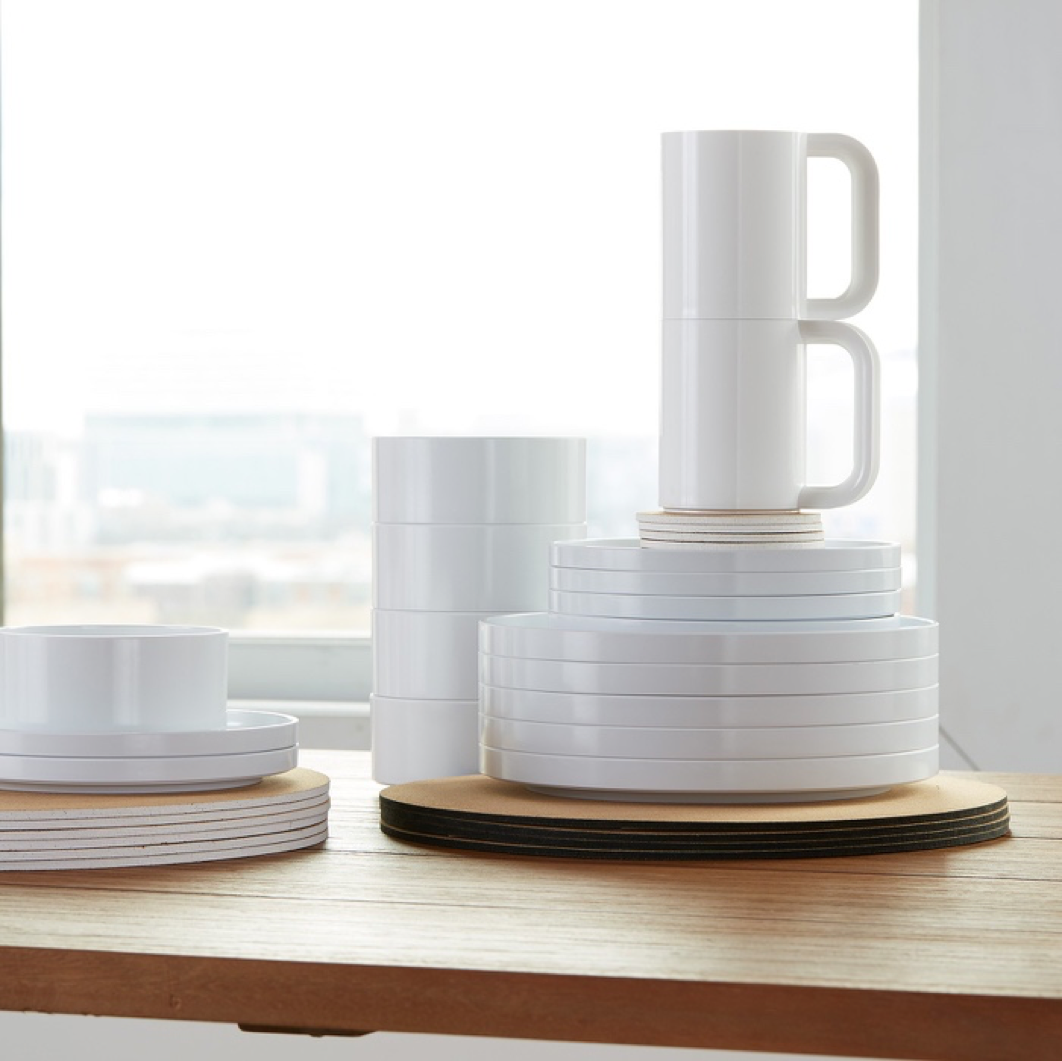
Lella was born into a family of Architects in Udine, Italy. She inevitably went to Architecture school where she met and married Architect Massimo. Together they travelled to America where Lella was employed and valued as an Interior Designer for Skidmore, Owings and Merrill. Her time there was short lived when their visa expired and they had to return back home. Once home, they established their own design firm Vignelli Associates and started strong by creating an award winning dinner stacking set made from melamine. As a result, their expertise was continually sort after which highlights how valuable they were.
As an Italian designer, Lella was experienced with working in different design fields. She was extremely pragmatic and grounded as a designer. Having a multidisciplinary background meant a lot of her designs were very well informed and I believe this is why she was so successful. Her design approach highlights one of subtraction rather than addition; refinement rather than excess. Her maxim in life was “if you do it right, it will last forever”. This motto is commonly mistaken to belong to Massimo even though he is quoted saying it always belonged to Lella (Sellers 2017).
Although working as a team, Lella noted that “there were many meetings with clients when the men spoke directly to Massimo and ignored [her]” (Seiler, Kirkham and Vignelli 2011). The blatant attitude obviously is example of biased gender views expressed from that era. As a result of ongoing unfair treatment, Lella had confessed to feeling resentment towards her own clients (Seiler, Kirkham and Vignelli 2011). Her under recognition is almost insulting especially considering she was balancing motherhood on top of her successful business. If Lella worked as much as the average working mum works today -roughly 98 hours a week (Santos 2018)- it would be rude to suggest she was anything but hardworking.
Having grown up in Udine, its people known for their long silences and few words, Lella was always one to tell it straight. According to Massimo, Lella played an extremely important role from the very beginning of their design life. “[Lella] is not a person-person; she’s the one who will come and say, ‘this is no good’… It’s a critical role” (M. Vignelli 2011).
Massimo and Lella Vignelli
1964
1971 was the year they founded Vignelli Associates but previous to that they had already designed everything from furniture to interiors. One of their better known designs in collaboration with Alan Heller was a compact dinner set that took advantage of the lightness and flexibility of melamine resin (Vignelli 2019). The award winning dinner ware can still be seen on the market today and exemplifies modularity, elegance, and most importantly timelessness. The set is a prime example of what it means to be good design (Christoforidou 2012). Its long and successful existence in the market are due to its effectiveness and timeless design. Their calculated refinement prefigured the minimalist aesthetic that was to sweep through design in the following decades (Sellers 2017).
The reoccurring problem I identified still remained in the way their designs were recognised. Many of the works the duo worked on solely recognised Massimo to be the designer. It’s uncertain why this underrepresentation still exists.
Why do I believe Lella was important? Lella was a well rounded designer and her intelligence was translated into informed designs. She practiced the process of subtracting which I believe is the most difficult thing to do as it is always easier to add than to simplify. She could identify and understand the absolute fundamentals of a project, thus, only designed something that was not on the market or was not already well done (Seiler, Kirkham and Vignelli 2011). On top of this, Lella managed to become a mother and sustain a successful business.
To finalise, Lella Vignelli was a significant character in the design field because she focused on the purest of design ideals. She was practical and always followed through with her work. Her strong work ethic shows through her decision to continue working instead of becoming a house wife. The ideas behind her designs were thoroughly thoughtful and well refined. Her designs had a real purpose and fulfilled a need within the market. I feel she is the epitome of the best kind of designer.
References
Christoforidou, Despina. “Good Taste vs Good Design: A Tug of War in the Light of Bling.” The Design Journal15, no. 2 (2012): 185-202.
Santos, Maricar. Working Mother.December 22, 2018. https://www.workingmother.com/when-you-factor-in-family-duties-average-working-mom-works-98-hours-week (accessed April 11, 2019).
Seiler, Melissa, Pat Kirkham, and Lella Vignelli. “Lella Vignelli on Vignelli: Design History, Concepts and Collaboration.” The University of Chicaco Press8, no. 1 (2011): 139-152.
Sellers, Libby. Women Design.London: Quarto, 2017.
Vignelli, Lella, and Massimo Vignelli. Design Within Reach.January 1, 2019. https://www.dwr.com/dining-dinnerware/heller-dinnerware-set/1075.html?lang=en_US (accessed April 8, 2019).
Vignelli, Massimo, interview by Mija Riedel. An Interview With Massimo Vignelli(June 6, 2011).

 Design Research
As a female designer who at times saw evidence of women being talked down to and undervalued in my internship last year, I found this blog post really insightful. I hadn’t heard of the Vignelli duo before but sadly wasn’t surprised that it was Massimo who has received more credit than Lella. I also admire that Lella’s design principles were based on “refinement rather than excess” because that is something I’ve always struggled with in my work. At times I hesitate to delete elements from my designs even though it might be for the better because it feels like I would’ve wasted time making that part in the first place. It’s so disappointing that in meetings, the clients would speak directly to Massimo and you’d think that would be different today, but that’s not always the case – as I saw happen in my internship last year. It was very eye-opening to be in a corporate environment and see that some of the men there still had this ‘old-school’ mentality that women’s voices aren’t as important. I’m glad that Massimo acknowledged the talent and worth of Lella and love that by choosing this as your topic, you are also honouring her name by spreading awareness of her talent and contribution.
I also like that you took a different approach with your blog posts by linking both of your blogs. A question I have for you is, do you think that Massimo would still receive the majority of recognition out of the pair if they were practitioners today? I think it could potentially be different because social media has changed the way designers can interact with the world, however we still live in a patriarchal society so maybe it actually wouldn’t be very different.
LikeLike