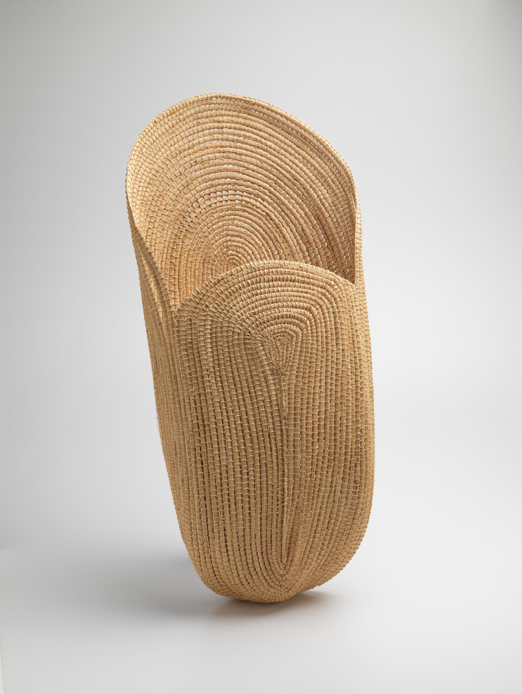
Yvonne Koolmatrie designs a series of weaving artworks by using the traditional Ngarrindjeri coil and bundle technique.The designer applies the special and old materials into such artworks, which makes the ancient culture and the handicraft be continued to be voiced in the world. At the same time, the skill and the material that Koolmatrie used in her design connect herself with her country and ancestors (Designing Women, 2018). She firmly inherits and develops weaving culture, regardless of how the world changes.
Koolmatrie is an Australian weaver who has lived all her life in Ngarrindjeri country (Art Gallery of NSW, 2014). The artwork shown in the figure 1 is a fish scoop wove by Koolmatrie. It is made from a local plant ‘sedge’ that grows along the Murray River in the country of the designer (Designing Women, 2018). The sedge as a medium, shows the conventional weaving techniques and the elegance of this artwork thoroughly. The Fish scoopis constructed from dried sedge rushes by using coiled basketry technique (Designing Women, 2018). The top is as wide as the bottom and there is a large, splayed opening at one end. The subtle smell, form and tone of the finished product clearly reflect the natural environment of the Murray River. Besides the cultural significance of the Fish scoopitself, it is functional. Women usually use it to collect fish caught in nets and to entrap fish and crayfish in the shallows (Designing Women, 2018). The Fish scoophas no redundant decoration, which emphasizes the value and the beauty of the material itself.
By adopting the indigenous technique and material, the series of weaving art pieces by Koolmatrie questions the true beauty of an artwork (McDonald, 2016). Although the Fish scoopembodies the delicate weaving technique, it has been commented as too monotonous to some extent. In my opinion, the Fish scoopshows the natural beauty without any ornament, which is different from most mainstream designs. The rejection of adding any patterns or painting it more colourful, to some degree, is another way to highlight the functionality and the material of the artwork. Everyone has different tastes about the beauty of an art piece. Some people prefer the decorative design. Meanwhile, some thoughts about the pure beauty that is considered useless (Christoforidou, 2012). For Koolmatrie, the material is everything to her artwork. It motivates she to insist the use of traditional skills. That is a gift of the old people who from Ngarrindjeri country (Designing Women, 2018). The artist has used sedge to weave since the 1980s and she never attempts to add patterns to make it more beautiful and attractive as the material is considered the true beauty of art by her.
In addition, the Fish scoop, as one of the representative works of Koolmatrie, has a strong influence on the publicity and development of the traditional weaving technology. With the rapid development of the digital medium and industrialization, the conventional craft is generally to be neglected. More seriously, for better adapting to the changing social and economic circumstances, some handcrafts are replaced by more digital and industrialized art forms that could be mass produced (Berry, 2012). To protect and spread the skills and materials from Ngarrindjeri country, Koolmatrie attempts to educate and affect future generations to inherit this ancient culture through her designs. She teaches weaving and basket making as the teaching is regard as a significant part of maintaining the vitality and prosperity of cultures and traditions (McDonald, 2016). As a designer who works on the communication of aboriginal culture, Koolmatrie are expected to maintain, control and develop the cultural expressions of her land (Martin, 2019).
Besides the functionality and aesthetics of the artwork itself, every piece of art has a duty and meaning behind it. The Fish scoopreminds us of the significance of the ancient culture of ancestors. Koolmatrie creates a bridge between past and present through a weaving. She crafts and shapes the natural material into an object with a practical or symbolic purpose. The use of sedge reflects the designer’s deep love for her hometown and her praise of nature. Furthermore, in the broadest sense, the fusion of art and special material that from hometown represents the consolidation of culture, of tradition, of family and country (McDonald, 2016). By the insistence of Koolmatrie, more people notice the importance of natural material and craft. The Fish scoop ispurchased by NGV Supporters of Indigenous Art in 2012 and displayed at the National Gallery of Victoria (NGV), one of the most influential art museum in Australia, which continues to educate and affect people (Designing Women, 2018). Under the impact of such artworks, many young artists are abandoning the simply ornamental and beautiful art. They are educated for concerning more about nature issues and the combination of their art, material and traditional technology (Poynor, 2013).
It is clear that the weaving artwork created by Koolmatrie has a significant impact on contemporary art and design. It not only challenges perceptions of contemporary indigenous art but also leads weaving art of Australian (Art Gallery of NSW, 2014). But my question is, although the weaving artwork of Koolmatrie emphasized the material, skill and functionality, is this single art form enough to attract the attention of audiences? How could the traditional technology and material be more widely publicized and how could the culture be better protected if it only relies on Koolmatrie and other weavers? In the changing social background, does the designer need to cater to the mainstream taste to avoid this art culture being forgotten?
In my opinion, the Fish scoopis a great art piece to help more people realize the significance of natural materials and the traditional crafts. Also, it reminds artists not to forget the most original and primary art and culture. This series of weaving artwork has a strong influence on reviving an ancient art culture that is in danger of disappearing. The work of the designer Koolmatrie is tightly connected with the Murray River of her country and the rich cultural heritage of the land. She has been at the forefront of the rediscovery and development of the weaving traditions to push the boundaries of the art form. The process is slow, but valuable.
Reference
Figure 1. Yvonne Koolmatrie, Fish scoop, 2010. Exhibited at National Gallery of Victoria (NGV).
Berry, Jess. 2012.Earthworks and Beyond. InThe Design Collective: An Approach to Practice,182-197. Cambridge Scholars Publishing.
Christoforidou, Despina. Olander, Elin. Warell, Anders. Svengren Holm, Lisbeth. 2012. “Good Taste vs. Good Design: A Tug of War in the Light of Bling.” The Design Journal, Vol.15, No. 2 (2012): 185- 202.
Designing Women, NGV International, Melbourne, accessed 28/09/2018.https://www.ngv.vic.gov.au/exhibition/designing-women/
Martin, Brain. 2019. TDN3001 Lecture about Indigenous Design Charter.
McDonald, John. 2016. Tarnanthi: Festival of Aboriginal and Torres Strait Islander Art.In Sydney Morning Herald Column.
Poynor, Rick. 2013. Inkahoots and Socially Concerned Design: Part 1. In Essays Design Observer.
Tradition today: Indigenous art in Australia, Art Gallery of New South Wales, Sydney, accessed 2014. https://www.artgallery.nsw.gov.au/collection/artists/koolmatrie-yvonne/

 Design Research