Maree Clarke is an aboriginal female designer of Australian. She has a cultural background from Mutti Mutti/Yorta Yorta and Boom Wurrung/Wemba Wemba. Her design work is enhanced by new technologies, ensuring that her practice is contemporary and current, and the next step in the continuum that is the oldest living culture in the world(MUMA page, 2019). Meditation on the relationship between tradition and modernity is a central element of Maree’s oeuvre(MUMA page, 2019).
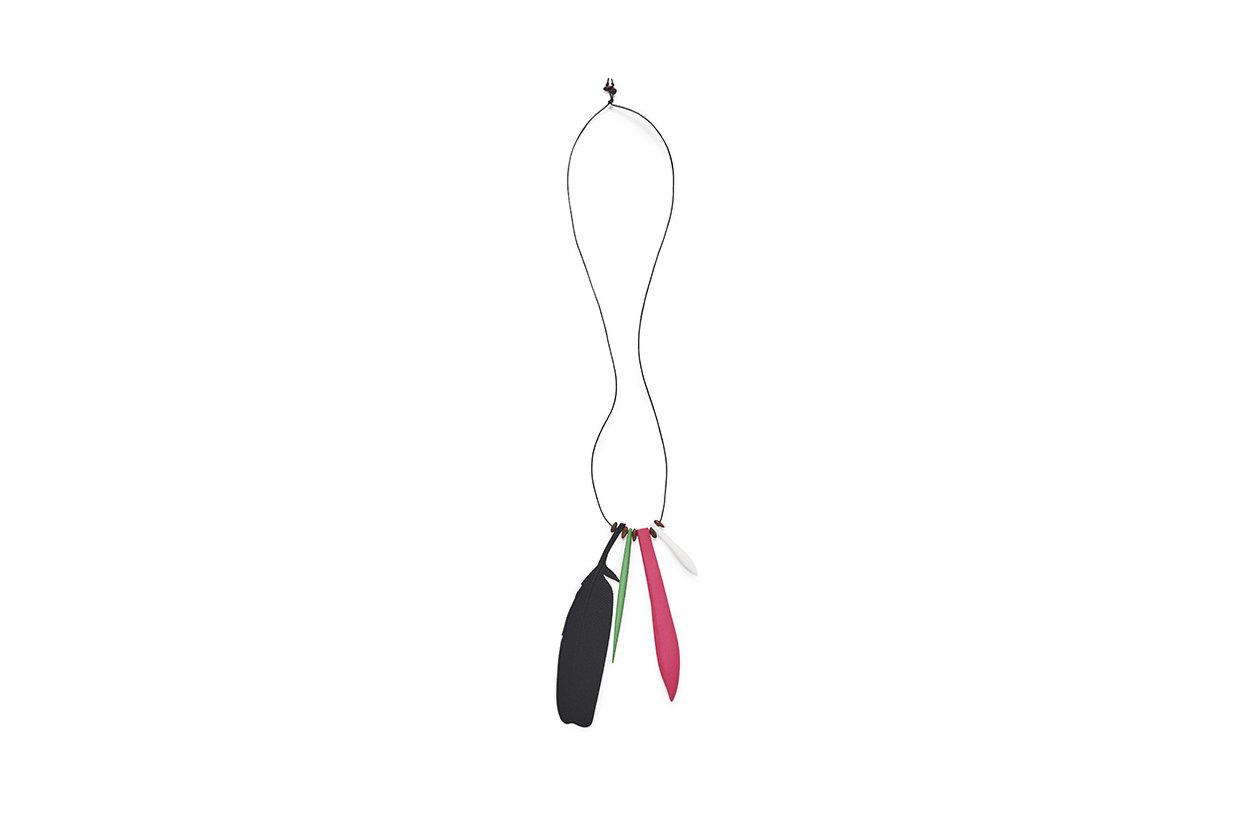
Her latest design work, shown in figure 1, is a collection of Jewelry that comes in gold plating, supersizing and 3d printed forms, they are shaped into the types of kangaroo teeth, quills, and feathers. Using organic material from animals for decoration is often seen as archaic and primitive. However, in this design, Maree Clarke endows cool color and texture for these natural forms. With these compositions, these animal body shapes illustrate concise and beautiful of contemporary jewelry design. In general, this work still communicates a traditional cultural practice. You can feel it is a design that passes on from an ancient ethnic in a form more acceptable to modern humans.
It is interesting that we can see an original cultural work is exhibited in the gallery exhibition now. According to Sharon West “As before this Indigenous art and cultural objects were generally perceived as ethnographic exhibits. They were systematically documented and cataloged for the nation’s anthropological museums and University collections(West, 2007).” Australian mainstream aesthetic didn’t recognize the value of these indigenous cultures as art in the past. Art was only considered as the right of the powerful culture such as Europe, Japan, America. This situation is inevitable; dominant cultures have carried on extensive esthetics research and discussion and define the foundations of modern aesthetics, especially in the 20th century. Although the idea of modernization is global and comprehensive, unfortunately, for historical reasons, Australian aboriginal people and culture were not being added to the family of artistic creation. The intellectual property of Australian aboriginal people was not fully respected by the public until the promulgation of the AICD: CD ( Australian Indigenous Design Charter: Communication Design ). The charter has detailed criteria to guide the promotion of Australian indigenous design” ensure Indigenous representation creation in design practice is Indigenous-led; respect for the rights of Indigenous peoples to oversee representation creation of their culture in design practice; always consider the reception and implications of all designs so that they are respectful to Indigenous culture(AICD, 2016).” We have known these aboriginals culture community for a long time, but their culture is always used as a background, shown as a primitive way of life in Hollywood films or video games without deep thinking. The AICD claim that Indigenous participants are not merely to be referenced, but are active participants in the process(AICD, 2016). To understand the aboriginal culture, we need more indigenous to participate as a professional designer and artist to spread their religion.
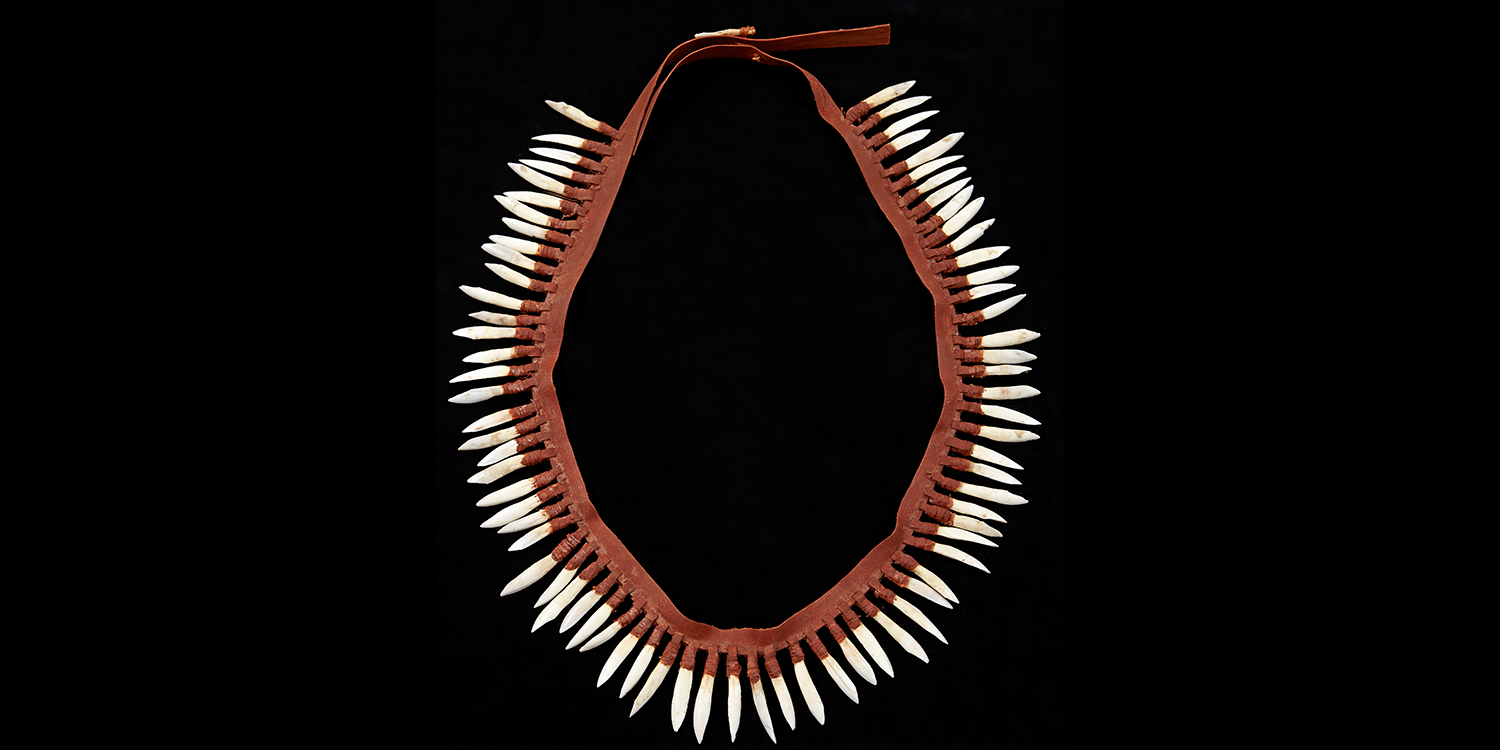
The 3D printed crow feather and gold plating kangaroo teeth is an essential sign of Maree Clarke’s design. Compare this to her previous configuration Thung-ung Coorong, shown in figure 2; a necklace makes out of real kangaroo teeth. The process of Thung-ung is more traditional. To make a necklace like Thung-ung Coorang 2013, Clarke first collected teeth from dead kangaroos on the roadside in Mildura and Broken Hill. Clarke was inspired to revive the tradition while visiting the Victorian museum’s collection of 19th-century kangaroo necklaces(MUMA, 2019). However, for the jewelry series, she considers the forms of kangaroo teeth and crow feathers as a symbol, there is no difference between a gold plating kangaroo teeth with a gold plating crucifix or gold plating buddha, they are all the cultural property left to us by our ancestors legacy that establishes a cultural identity with your group . As Maree said in a conversation “As a mob, we call Ravens and Crows Waa, they are watchers of the waterways” crow play as a different role in Boon Wurrung culture, it is a family story of them. It is glad to see the aboriginal artist to work as the leader to experiment with new methods to pass their culture to the next generation.
This work triggered my reflection on the culture of the minority group. Does our world miss out plentiful, great design from multi-culture background people? We see a lot of dress, jewelry, and even architecture design that design based on a reference of minority culture. Designers easily take away the element they think is unique to make their work success, but these elements may have been misinterpreted from its original culture. The demands of the minority cultural groups and their cultural inheritance are ignored. The primary purpose of an aboriginal designer is not to design extraordinary; it is to spread their own culture to the world and carry on to the descendant.
The series of jewelry is excellent, it showed the potential of aboriginal designers, it represents every object displayed in museum or historical may be redesign to get public recognition, to regain its function in life, and remain its spiritual values. This project needs more indigenous designers to engage.
Reference
Sharon West, 2007. Old messages, new media: Jarrod Atkinson, Maree Clarke, Gary Lee, Genevieve Grieves, Dixon Patten, Allan Wickey (Brunswick, Vic. : Counihan Gallery in Brunswick Press,2007).
Rhall Steven, 2017. In conversation – Maree Clarke and Steven Rhall, Indigenous Art, Art–Exhibitions, Photofile, Vol. 100, 2017: 116-121
Arts Law Centre of Australia (2012). Indigenous Australian Art Commercial Code of Conduct.Retrieved 10 March 2016 from http://www.aitb.com.au/information-sheets/entry/indigenous australian-art-commercial-code-of-conduct
Arts Law Centre of Australia (2016). Artists in the Black: Information Sheet. Retrieved 20 October 2015 from http://www.aitb.com.au/information-sheets/entry/solid-arts-the-visual-arts and-crafts
The Design Files
Accessed 10/4/2019
https://thedesignfiles.net/2018/03/maree-clarke/
Vivien Anderson Gallery
Accessed 10/4/2019
http://www.vivienandersongallery.com/artists/maree-clarke/bio

 Design Research
You have chosen an attractive article that really drag my eyes into it. From your topic, I learned that the tradition culture from Australian indigenous is losing. This made me thinking that China minority has the same situation as the losing culture of Australian indigenous. Australia are training indigenous designers to culture heritage. Mareer Clarke is an indigenous designer that had mentioned in your topic and I have research some of her works; and I really loved what she has done by using the 3D print technology. According to your topic, I understand that the method Mareer Clarke used to created products recently was a combination of traditional handmade and 3D print. The idea behind this method is to make people accept the losing of Australian indigenous culture. Mareer Clarke has making effort on taking care of indigenous culture.
I understand that there was some great works behind this fantastic idea of culture heritage, but I wondered that is the tradition culture product made by Mareer Clarke takes the same value as a luxury product or a normal product? As a culture heritage product, is it possible to sale oversea and let people realise how important the culture heritage is?
LikeLike